Revision summary
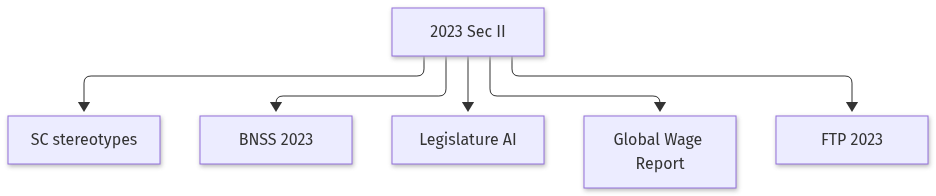
Contemporary governance bundle: judicial anti-stereotype jurisprudence, criminal procedure code replacement, legislative tech caution, ILO wage trends, and export promotion pillars.
Model answer
Introduction
Section II 2023 mixes judicial reform, criminal law, technology, labour global report, and trade policy.
Body
Supreme Court on Gender Stereotypes
- Peg: Courts caution against language stereotyping women victims and mothers in judgments; handbook-style guidance circulated.
- Peg: Reinforces Article 15 dignity and fair-trial integrity.
Bharatiya Nagarik Suraksha Sanhita, 2023
- Peg: Replaces IPC-aligned CrPC with updated procedures: timelines, forensic norms, digital records, victim-centric provisions.
- Peg: Federal–state police coordination and court digitisation stress implementation capacity.
AI in Legislative Decision-Making
- Peg: Potential for bill scrutiny, translation, committee summaries; risks of bias, opacity, and democratic accountability.
- Peg: Legislatures need human oversight and disclosure norms — not automation of voting.
Global Wage Report 2022–23 (ILO)
- Peg: Highlights real wage erosion in inflation shocks; gender pay gaps and informal sector vulnerabilities.
- Peg: India relevance: gig workers, minimum wage federalism, Bihar migration wages.
Foreign Trade Policy 2023
- Peg: Targets USD 2 trillion exports by 2030 framework; e-commerce hubs, district export promotion, remission schemes.
- Peg: Bihar food processing and services exports can leverage ODOP-style branding if quality met.
Flow diagram
Conclusion
Together these themes show judiciary, criminal law modernisation, cautious tech adoption, labour realism, and export ambition interlocking in New India governance.
Quick related
Students also ask
-
(a) Provide a brief overview of the Manipur crisis. In your view, what could be the potential repercussion of this ethno-religious conflict on the landscape of national politics? Comment.
Or
(b) How does India’s leadership within the G-20 reflect its commitment to upholding the ancient philosophy of ‘Vasudhaiva Kutumbakam’ (the world is one family)? Examine the ways in which India’s approach aligns with this philosophy and contributes to global cooperation and development through its role in the G-20.
Next question on this syllabus topic (2023 · Q5). View answer →
-
Does BNSS change police powers overnight?
Requires training, rules, and state adaptation — law on books is first step.
-
Can AI draft laws?
Only as assistive input; democratic legitimacy requires elected deliberation.
More from this topic
Q8 · UPSC Mains 2025 · GS I · 36 marks · Solution
Section III statistical / graph / diagram question continuing from the official booklet (Fig. 1 persons aged 60+ by gender and residence, and remaining sub-questions). See media/pyq/2025/BPGS1-english.pdf for the printed figures and full sub-parts.
General Studies I
Fig. 1 items typically combine bar or pie readings on elderly population by gender and rural–urban residence; approach mirrors percentage change, share comparison, and dual-filter reading.
Q7 · UPSC Mains 2025 · GS I · 36 marks · Solution
In respect of hospital data given in Table 1, answer the following questions. (Table in official booklet — July 2025 hospital outcome data by department and gender.) (a) Which department has highest percentage of female patients? (b) What is ratio of Neurology patients to Cardiology patients among male patients? (c) Which departments have more than one-fourth of the total admissions, respectively in each gender category? (d) Which department has highest ratio of specialized care to cured ratio for male and female combined group? (e) If one more female was admitted to specialized care and cured category each and one less male under cured category in the Cardiology department, then what would be the overall ratios of specialized care to cured under each gender? Or In respect of data from Fig. 1 for population aged above 60, answer the questions that follow. (Figure in official booklet.)
General Studies I
Method-focused WRAP for Section III Table 1: filters female share by department, male neurology-to-cardiology ratio, departments exceeding one-fourth admissions, specialised-care-to-cured ratios, and the stated counterfactual in cardiology — all computed strictly from the printed booklet.
Q6 · UPSC Mains 2025 · GS I · 38 marks · Solution
(a) In recent years, the Chhath festival has gained increasing global attention. Discuss the Social, cultural and economic impact of Chhath and its linkages with migration. Or (b) Bihar has emerged as the top-performing state in the country in the ‘Prime Minister Formalization Micro Food Processing Enterprises Upgradation’ (PMFME) Scheme. Analyse the potential PMFME towards contribution in the economic development of the Urban and Rural areas in Bihar.
General Studies I
Chhath is a lunar festival venerating Surya and Chhathi Maiya, concentrated in Bihar–Purvanchal; diaspora celebration, reverse migration, and local informal economy effects make it a transnational cultural asset with measurable remittance and tourism spillovers.