Revision summary
From colonial colleges to provincial university (1917) and post-1947 expansion, education shaped Bihar's political class and structural underdevelopment paradox.
Model answer
Introduction
Modern education arrived unevenly — strong in Patna, weaker in Mithila villages.
Body
Nineteenth-Century Foundations
- Peg: Patna College, vernacular schools, and missionary education built Anglicised middle class.
Early Twentieth Century
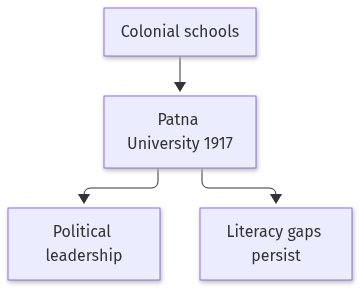
- Peg: Bihar division from Bengal (1912); Patna University 1917 consolidated colleges.
- Peg: Graduates led Champaran, Non-Cooperation, and Kisan Sabha movements.
Impact on Politics
- Peg: Lawyer-politicians dominated Congress ministries; Hindi press amplified mass messages.
- Peg: Muslim educated elite participated in League and Congress coalitions pre-Partition.
Economic and Social Impact
- Peg: Bureaucratic employment outlet; limited industrial skill pipelines until engineering institutes grew.
- Peg: Female education lagged; reformists promoted girls' schools.
Post-Independence
- Peg: University proliferation, IIT Patna, medical colleges; yet literacy gaps persist versus national averages.
- Peg: Migration of educated youth to metros remains structural outcome.
Flow diagram
Conclusion
Modern education empowered Bihar's nationalist elite while leaving rural literacy and industry linkages unresolved — a dual legacy for policy.
Quick related
Students also ask
-
Answer the following questions:
(a) Explain the concern of the Supreme Court of India on combating gender stereotypes.
(b) Examine the relevance of the Bharatiya Nagarik Suraksha Sanhita, 2023 in Indian governance system.
(c) Evaluate the role of Artificial Intelligence in decision-making process of the Legislative institutions.
(d) Describe the parameters and impacts of the Global Wage Report, 2022-23.
(e) What are the basic provisions of the Foreign Trade Policy, 2023 regarding export promotion initiatives in India?
Next question on this syllabus topic (2023 · Q4). View answer →
-
Did education reduce poverty in colonial Bihar?
It mainly produced middle-class nationalism; agrarian poverty required separate movements.
-
Role of Hindi in schools?
Vernacular streams grew alongside English collegiate education.
More from this topic
Q8 · UPSC Mains 2025 · GS I · 36 marks · Solution
Section III statistical / graph / diagram question continuing from the official booklet (Fig. 1 persons aged 60+ by gender and residence, and remaining sub-questions). See media/pyq/2025/BPGS1-english.pdf for the printed figures and full sub-parts.
General Studies I
Fig. 1 items typically combine bar or pie readings on elderly population by gender and rural–urban residence; approach mirrors percentage change, share comparison, and dual-filter reading.
Q7 · UPSC Mains 2025 · GS I · 36 marks · Solution
In respect of hospital data given in Table 1, answer the following questions. (Table in official booklet — July 2025 hospital outcome data by department and gender.) (a) Which department has highest percentage of female patients? (b) What is ratio of Neurology patients to Cardiology patients among male patients? (c) Which departments have more than one-fourth of the total admissions, respectively in each gender category? (d) Which department has highest ratio of specialized care to cured ratio for male and female combined group? (e) If one more female was admitted to specialized care and cured category each and one less male under cured category in the Cardiology department, then what would be the overall ratios of specialized care to cured under each gender? Or In respect of data from Fig. 1 for population aged above 60, answer the questions that follow. (Figure in official booklet.)
General Studies I
Method-focused WRAP for Section III Table 1: filters female share by department, male neurology-to-cardiology ratio, departments exceeding one-fourth admissions, specialised-care-to-cured ratios, and the stated counterfactual in cardiology — all computed strictly from the printed booklet.
Q6 · UPSC Mains 2025 · GS I · 38 marks · Solution
(a) In recent years, the Chhath festival has gained increasing global attention. Discuss the Social, cultural and economic impact of Chhath and its linkages with migration. Or (b) Bihar has emerged as the top-performing state in the country in the ‘Prime Minister Formalization Micro Food Processing Enterprises Upgradation’ (PMFME) Scheme. Analyse the potential PMFME towards contribution in the economic development of the Urban and Rural areas in Bihar.
General Studies I
Chhath is a lunar festival venerating Surya and Chhathi Maiya, concentrated in Bihar–Purvanchal; diaspora celebration, reverse migration, and local informal economy effects make it a transnational cultural asset with measurable remittance and tourism spillovers.