Revision summary
Nalanda–Vikramashila universities, Pataliputra scholastic hub, Buddhist–Jain–Ajivika pluralism, and Gupta–Pala intellectual networks justify the claim.
Model answer
Introduction
Magadha's geography fed agricultural surplus supporting monastic universities and imperial patronage.
Body
Ancient Centres of Learning
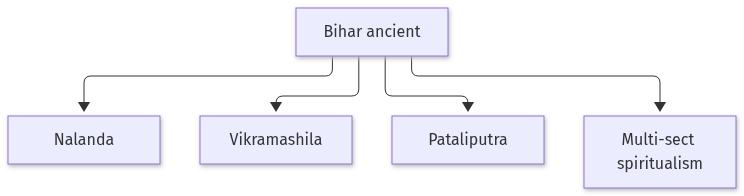
- Peg: Nalanda mahavihara (from Gupta era, flourished under Palas) attracted international scholars (Xuanzang, I-tsing).
- Peg: Vikramashila (Bhagalpur region) rivalled Nalanda in tantric and philosophical curriculum.
- Peg: Pataliputra hosted Secular–Buddhist debates and Mauryan imperial scribe schools.
Spiritual Traditions
- Peg: Buddhism's eastern heartland; Mahavira's Bihar links; Ajivika ascetics in Barabar caves.
- Peg: Syncretic folk cults along Ganga sangam zones.
Intellectual Exchange
- Peg: Manuscript copying, logic (pramana), astronomy, medicine codified in monastic syllabi.
- Peg: Trade routes spread Magadhan scholarship to Nepal, Tibet, and Southeast Asia.
Medieval Continuity
- Peg: Pala patronage sustained viharas until invasions; decline of Nalanda not total erasure of Bihari scholastic memory.
Modern Echoes
- Peg: Patna University and revivalist Hindi–Urdu movements claim lineage to ancient learning capital status.
Flow diagram
Conclusion
Bihar's ancient learning–spiritual complex is historically grounded in Nalanda–Vikramashila and plural ascetic traditions — not mere slogan.
Quick related
Students also ask
-
(a) Critically examine the contribution of moderate phase of the Indian National Congress Movement.
Or
(b) Trace the development of modern education in Bihar and its impact.
Next question on this syllabus topic (2023 · Q3). View answer →
-
When did Nalanda decline?
Scholarly consensus ties major destruction to early thirteenth-century raids; exact chronology debated.
-
Is the claim only Buddhist?
No — Jain, Ajivika, and Brahmanical streams coexisted in Magadhan intellectual life.
More from this topic
Q8 · UPSC Mains 2025 · GS I · 36 marks · Solution
Section III statistical / graph / diagram question continuing from the official booklet (Fig. 1 persons aged 60+ by gender and residence, and remaining sub-questions). See media/pyq/2025/BPGS1-english.pdf for the printed figures and full sub-parts.
General Studies I
Fig. 1 items typically combine bar or pie readings on elderly population by gender and rural–urban residence; approach mirrors percentage change, share comparison, and dual-filter reading.
Q7 · UPSC Mains 2025 · GS I · 36 marks · Solution
In respect of hospital data given in Table 1, answer the following questions. (Table in official booklet — July 2025 hospital outcome data by department and gender.) (a) Which department has highest percentage of female patients? (b) What is ratio of Neurology patients to Cardiology patients among male patients? (c) Which departments have more than one-fourth of the total admissions, respectively in each gender category? (d) Which department has highest ratio of specialized care to cured ratio for male and female combined group? (e) If one more female was admitted to specialized care and cured category each and one less male under cured category in the Cardiology department, then what would be the overall ratios of specialized care to cured under each gender? Or In respect of data from Fig. 1 for population aged above 60, answer the questions that follow. (Figure in official booklet.)
General Studies I
Method-focused WRAP for Section III Table 1: filters female share by department, male neurology-to-cardiology ratio, departments exceeding one-fourth admissions, specialised-care-to-cured ratios, and the stated counterfactual in cardiology — all computed strictly from the printed booklet.
Q6 · UPSC Mains 2025 · GS I · 38 marks · Solution
(a) In recent years, the Chhath festival has gained increasing global attention. Discuss the Social, cultural and economic impact of Chhath and its linkages with migration. Or (b) Bihar has emerged as the top-performing state in the country in the ‘Prime Minister Formalization Micro Food Processing Enterprises Upgradation’ (PMFME) Scheme. Analyse the potential PMFME towards contribution in the economic development of the Urban and Rural areas in Bihar.
General Studies I
Chhath is a lunar festival venerating Surya and Chhathi Maiya, concentrated in Bihar–Purvanchal; diaspora celebration, reverse migration, and local informal economy effects make it a transnational cultural asset with measurable remittance and tourism spillovers.