Revision summary
This Section-II composite addresses agro-processing bottlenecks, jute agro-climate in the Ganga basin, digital and inclusive pillars of Viksit Bharat, geothermal potential, and South Bihar’s Nalanda–Magadh–Aurangabad development push.
Model answer
Introduction
GS-II’s economic-geography segment links farm-sector modernisation, fibre geography, green energy, and sub-regional planning — all central to Bihar’s transition from agriculture-heavy employment to value-added, resilient growth.
Body
Food Processing — Challenges and Policy
- Challenges: High post-harvest losses (25–30% in fruits/vegetables), fragmented cold chain, MSME capital gaps, standards compliance costs, and weak farm–processor contracts.
- Initiatives: PMKSY (integrated cold chain), Mega Food Parks, PLI for food products, Operation Greens, FSSAI harmonisation, and One District One Product pushes.
Jute in West Bengal and Bihar
- Demand drivers: Biodegradable packaging, cheapness, tensile strength, uniformity — jute suits eco-conscious sacking and geotextiles.
- Conditions: Hot humid climate (24–35 °C), 150–250 cm rainfall, fertile alluvial gangetic soils, abundant labour, proximity to Kolkata mills and Haldia port.
- Bihar pockets: Purnia, Katihar, Bhagalpur belt; raw fibre supply with processing in WB corridor.
Atmanirbhar / Viksit Bharat Pillars
- Natural resource management: Soil health cards, watershed programmes, Jal Jeevan Mission — sustainable input base.
- Inclusive development: DBT, MGNREGA, SC/ST/OBC entrepreneurship schemes reducing regional disparities.
- E-technology: GeM, UPI, ONDC, AgriStack, drone spraying — logistics and market access for small producers.
Geothermal Energy
- Benefits: Baseload-capable renewable heat/electricity, low emissions, district heating potential.
- India examples: Puga–Chumathang (Ladakh), Tattapani (Chhattisgarh), Cambay basin exploratory projects; social co-benefits in remote cold deserts via stable heat supply.
South Bihar (Last Decade)
- Connectivity: NH upgrades, Gaya airport expansion, Buddhist circuit tourism.
- Education/skills: IIT Patna outreach, Bihar Skill Development Mission centres.
- Agriculture: Organic clusters, makhana/value-add in Gaya–Nalanda; floods management on Phalgu–Falgu basin.
- Welfare: Jal Jeevan, PM Awas, health sub-centres strengthening in aspirational blocks.
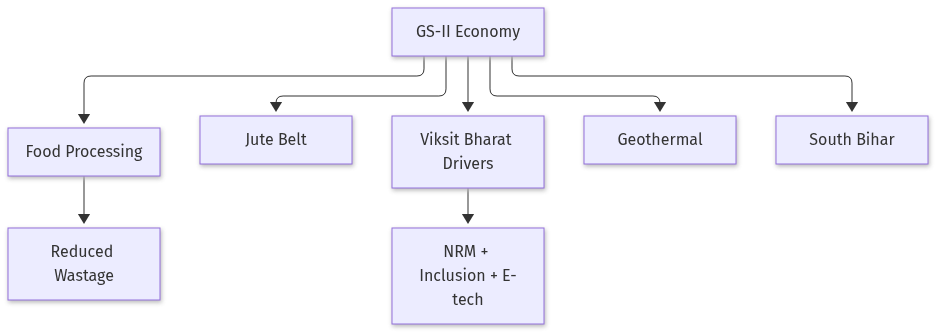
Flow diagram
Conclusion
Integrated food processing, fibre geography, geothermal pilots, and South Bihar’s circuit-based development exemplify how natural resource stewardship, inclusion, and e-technology jointly advance Atmanirbhar Bharat and the Viksit Bharat 2047 vision.
Quick related
Students also ask
-
(a) Discuss the role of railway in the development of country. Critically analyze the geographical, economic and political challenges faced by Indian Railways in enhancing its logistics efficiency in north-eastern part of country?
Or
(b) What are the components of food security? How far hydroponic agriculture will be helpful to fulfil the future domestic demands in country? Justify it with suitable examples.
Next question on this syllabus topic (2025 · Q5). View answer →
-
Why does jute concentrate in the lower Ganga basin?
Alluvial soils, monsoon humidity, cheap labour, and historic mill proximity in Kolkata make West Bengal dominant, with Bihar supplying raw fibre.
-
What hampers India’s food processing competitiveness?
Weak cold chains, small-scale units, compliance costs, and inconsistent farm–industry linkage raise wastage and unit costs.
More from this topic
Q8 · UPSC Mains 2025 · GS II · 36 marks · Solution
(a) In the perspective of the basics of cyber security, the need for digital sovereignty and the effectiveness of the Prevention of Money Laundering Act (PMLA), suggest components for a comprehensive internal security strategy. Or (b) “The New Indian Space Policy 2023 has opened the floodgates for the private sector.” Is this transition merely about technological development, or has it qualitatively transformed India’s capabilities for national security disaster response and border management? In the context of drone swarm technology, the security of satellite based communication and the strategic significance of GSLV program, propose the essential pillars of a comprehensive ‘Security-Development-Innovation’ strategy for India’s space and allied technologies.
General Studies II
India’s internal security and strategic posture increasingly depend on space-based C4ISR, private innovation under the 2023 Space Policy, and allied technologies (drones, secure satcom, GSLV-class lift) for disaster and border missions.
Q7 · UPSC Mains 2025 · GS II · 36 marks · Solution
Write short answer of the following questions: (See official booklet Section III short notes — cyber security / digital sovereignty / PMLA components and remaining short parts in media/pyq/2025/BPGS2-english.pdf.) In the perspective of the basics of cyber security, the need for digital sovereignty and the effectiveness of the Prevention of Money Laundering Act (PMLA), suggest components for a comprehensive internal security strategy. (Full short-note set: official PDF.)
General Studies II
Internal security in a digital age requires cyber resilience, sovereign control over critical data infrastructure, and anti-money-laundering architecture — PMLA being one pillar among intelligence, policing, and border coordination.
Q6 · UPSC Mains 2025 · GS II · 38 marks · Solution
(a) Discuss the major ports on eastern coast of India. Critically examine the role of Syama Prasad Mookerjee Port, Kolkata (SMPK) in the development of North East India and Bangladesh, giving suitable examples. Or (b) Describe the concept of fourth industrial revolution (Industry 4.0). Critically analyse the biggest benefits and risks of adopting industry 4.0 technologies in India.
General Studies II
Eastern seaboard ports anchor coal, container, and bulk trade for eastern India; SMPK (Kolkata) retains historic hinterland ties to North-East India and Bangladesh via river-sea multimodal networks despite draft limitations.