Revision summary
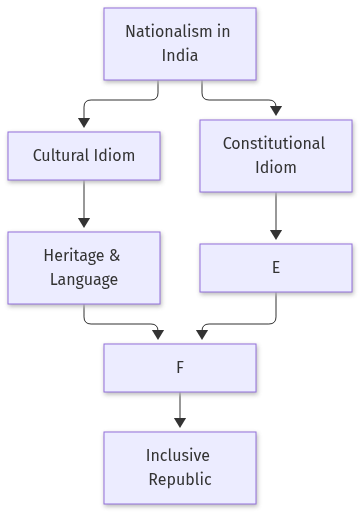
Cultural nationalism emphasises shared civilisational heritage; constitutional nationalism grounds belonging in republican citizenship, rights, and institutions. India’s Constitution accommodates both through pluralism, secular statecraft, and inclusive nationhood.
Model answer
Introduction
Nationalism in India has historically blended civilisational memory with anti-colonial constitutionalism. The tension and convergence between cultural and constitutional idioms shape contemporary debates on identity, citizenship, and state neutrality.
Body
Meeting Points
- Anti-colonial unity: Both traditions resisted imperial domination — one through cultural revival (language, religion, folk memory), the other through rights, federalism, and democratic institutions.
- Plural nationhood: Constitutional nationalism explicitly celebrates unity in diversity (Preamble, Article 51A); cultural nationalism, when inclusive, mirrors the same plural ethos (Gandhi–Tagore–Ambedkar syntheses).
- Institutional patriotism: Respect for the Constitution, flag, and republican offices can align with pride in Indic/South Asian heritage when neither is forced into majoritarian exclusivism.
Constitutional Safeguards for Culture
- Secular State (Article 25–28): Freedom of religion; no State religion; culture protected without State endorsement of any one faith.
- Language and minorities (Articles 29–30): Right to conserve language/script/culture; minority educational rights.
- Federal cultural autonomy: States promote regional languages (Eighth Schedule); official language policy balances Hindi, English, and regional tongues.
- DPSPs (Articles 38, 44, 47): Social justice, uniform civil code direction, and welfare — framing culture within equitable citizenship.
Limits and Healthy Balance
- Risk of majoritarian cultural nationalism: Can marginalise minorities and reinterpret history instrumentally; courts have intervened (e.g., hate speech, beef bans, textbook controversies).
- Constitutional correction: Basic structure, FRs, and secularism jurisprudence keep cultural projects within democratic bounds.
Flow diagram
Conclusion
India’s viable nationalism is constitutional first — rights, federalism, and secular governance — while culturally enriched through voluntary heritage, languages, and arts. Meeting points exist when culture expresses inclusion; divergence becomes dangerous when culture claims state monopoly over citizenship.
Quick related
Students also ask
-
(a) Parliament’s power to amend the Constitution is limited power and it cannot be enlarged into absolute power. Can Parliament under Article 368 destroy the Basic Structure of the constitution when it enjoys absolute majority in Parliament.
Or
(b) Critically analyze the impact of India’s multi-party system on the stability and functions of its federal structure. To what extent have coalition governments strengthened or weakened the cooperative and competitive dimensions of Indian federalism? Explain.
Next question on this syllabus topic (2025 · Q3). View answer →
-
Can cultural nationalism coexist with secular constitutionalism?
Yes, when cultural pride is voluntary, plural, and non-coercive; the State remains neutral and guarantees equal citizenship.
-
Which constitutional articles protect cultural diversity?
Articles 29–30 protect minority culture and education; the Eighth Schedule and language provisions reinforce regional cultural autonomy.
More from this topic
Q8 · UPSC Mains 2025 · GS II · 36 marks · Solution
(a) In the perspective of the basics of cyber security, the need for digital sovereignty and the effectiveness of the Prevention of Money Laundering Act (PMLA), suggest components for a comprehensive internal security strategy. Or (b) “The New Indian Space Policy 2023 has opened the floodgates for the private sector.” Is this transition merely about technological development, or has it qualitatively transformed India’s capabilities for national security disaster response and border management? In the context of drone swarm technology, the security of satellite based communication and the strategic significance of GSLV program, propose the essential pillars of a comprehensive ‘Security-Development-Innovation’ strategy for India’s space and allied technologies.
General Studies II
India’s internal security and strategic posture increasingly depend on space-based C4ISR, private innovation under the 2023 Space Policy, and allied technologies (drones, secure satcom, GSLV-class lift) for disaster and border missions.
Q7 · UPSC Mains 2025 · GS II · 36 marks · Solution
Write short answer of the following questions: (See official booklet Section III short notes — cyber security / digital sovereignty / PMLA components and remaining short parts in media/pyq/2025/BPGS2-english.pdf.) In the perspective of the basics of cyber security, the need for digital sovereignty and the effectiveness of the Prevention of Money Laundering Act (PMLA), suggest components for a comprehensive internal security strategy. (Full short-note set: official PDF.)
General Studies II
Internal security in a digital age requires cyber resilience, sovereign control over critical data infrastructure, and anti-money-laundering architecture — PMLA being one pillar among intelligence, policing, and border coordination.
Q6 · UPSC Mains 2025 · GS II · 38 marks · Solution
(a) Discuss the major ports on eastern coast of India. Critically examine the role of Syama Prasad Mookerjee Port, Kolkata (SMPK) in the development of North East India and Bangladesh, giving suitable examples. Or (b) Describe the concept of fourth industrial revolution (Industry 4.0). Critically analyse the biggest benefits and risks of adopting industry 4.0 technologies in India.
General Studies II
Eastern seaboard ports anchor coal, container, and bulk trade for eastern India; SMPK (Kolkata) retains historic hinterland ties to North-East India and Bangladesh via river-sea multimodal networks despite draft limitations.