Revision summary
This answer traces the shift in Indian party politics from the Congress system of one-party dominance to fluid coalition governments, analyzing its impact on the institutional authority of the Prime Minister. It then examines the contentious role of the Governor as a bridge between the Centre and States, focusing on the spoils system of transfers and the specific constitutional bounds of gubernatorial discretion. Key constitutional provisions, Sarkaria and Punchhi Commission recommendations, and landmark Supreme Court judgments are integrated to provide a balanced, highly analytical perspective.
Model answer
Introduction
The evolution of Indian democracy presents a fascinating continuum from the hegemonic one-party dominance of the post-independence era to fractured, consensus-driven coalition frameworks. Concurrently, the federal architecture is mediated by the office of the Governor, whose dual role as a constitutional head and a central link often faces severe strain during political transitions at the national level.
Body
Genesis and Decline of Single-Party Dominance
- Peg: The early decades post-1947 were characterized by the Congress System, a term coined by Rajni Kothari, denoting a central party of consensus operating within a competitive multi-party periphery.
- Peg: Social coalitions within a single umbrella party ensured stability, but successive socio-economic churns, regional aspirations, and the Emergency led to the gradual erosion of this dominance by the late 1960s and decisively by 1989.
Rise of Coalition Governments
- Peg: The post-1989 era witnessed the demise of single-party majorities and the ascendancy of the Mandal-Mandir socio-political axis, regional satraps, and opportunistic alliances.
- Peg: Coalition governance necessitated a shift from majoritarian assertion to a culture of common minimum programmes, intense bargaining federalism, and accommodation of regional interests.
Impact on the Prime Minister's Authority
- Peg: Coalition politics constrained the unilateral exercise of executive power, requiring Prime Ministers like P.V. Narasimha Rao, A.B. Vajpayee, and Manmohan Singh to function through consensus-building and managing allies rather than commanding absolute legislative loyalty.
- Peg: However, rather than fatally undermining the office, strong leaders utilized coalition management as an art of survival; the authority shifted from raw command to negotiation, though institutional friction undeniably increased.
The Governor as a Federal Bridge and the Spoils System
- Peg: The Governor acts as the vital constitutional conduit between the Union and the State, intended to act as an independent umpire rather than an agent of the ruling party at the Centre.
- Peg: The recurring trend of mass resignations or summary dismissals of Governors upon a change of government at the Centre reduces the office to a political spoil system, violating the spirit of federal autonomy.
Constitutional Discretion of the Governor
- Peg: Under Article 163, the Governor acts on the aid and advice of the Council of Ministers, except where the Constitution expressly requires him to act in his discretion, such as in the reservation of bills for the President (Article 200) or inviting a Chief Minister in a hung assembly.
- Peg: Landmark jurisprudence, notably the S.R. Bommai case (1994) and Nabam Rebia judgment (2016), held that gubernatorial discretion is not arbitrary and must be exercised in accordance with constitutional objectivity rather than subjective political whims.
Flow diagram
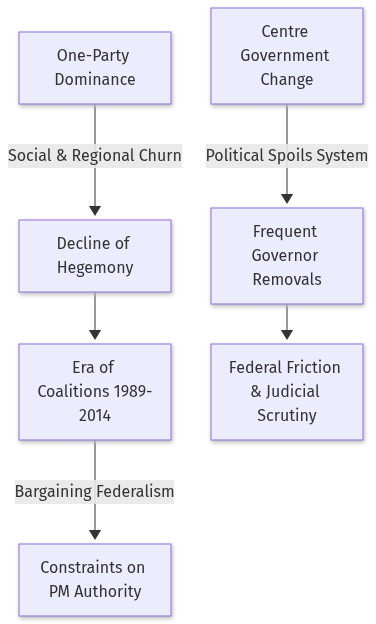
Conclusion
The trajectory of Indian democracy demonstrates that neither coalition politics nor federal friction are inherent systemic flaws, but rather reflections of a deeply plural society. Preserving the institutional sanctity of the Prime Minister's office and insulating the gubernatorial chair from partisan churn requires strict adherence to committee recommendations like Sarkaria and Punchhi, ensuring that cooperative federalism remains the guiding ethos of Indian constitutionalism.
Quick related
Students also ask
-
(a) “Besides being a medium of communication, language has also been effective as a symbol of identity”. In the light of this statement analyse the political impact of linguistic identity in India.
Or
(b) Write an essay on the political and constitutional changes in Jammu and Kashmir after the abrogation of Article – 370.
Next question on this syllabus topic (2024 · Q3). View answer →
-
How did the shift from one-party dominance to coalition politics impact the Indian political system?
The shift dismantled the Congress system, gave rise to regional parties, institutionalized bargaining federalism, and necessitated consensus-driven governance models.
-
Can the Governor exercise absolute discretion in State politics?
No, gubernatorial discretion is limited to specific constitutional provisions like reserving bills under Article 200 or handling hung assemblies, and it is subject to judicial review as per Supreme Court rulings.
More from this topic
Q8 · UPSC Mains 2025 · GS II · 36 marks · Solution
(a) In the perspective of the basics of cyber security, the need for digital sovereignty and the effectiveness of the Prevention of Money Laundering Act (PMLA), suggest components for a comprehensive internal security strategy. Or (b) “The New Indian Space Policy 2023 has opened the floodgates for the private sector.” Is this transition merely about technological development, or has it qualitatively transformed India’s capabilities for national security disaster response and border management? In the context of drone swarm technology, the security of satellite based communication and the strategic significance of GSLV program, propose the essential pillars of a comprehensive ‘Security-Development-Innovation’ strategy for India’s space and allied technologies.
General Studies II
India’s internal security and strategic posture increasingly depend on space-based C4ISR, private innovation under the 2023 Space Policy, and allied technologies (drones, secure satcom, GSLV-class lift) for disaster and border missions.
Q7 · UPSC Mains 2025 · GS II · 36 marks · Solution
Write short answer of the following questions: (See official booklet Section III short notes — cyber security / digital sovereignty / PMLA components and remaining short parts in media/pyq/2025/BPGS2-english.pdf.) In the perspective of the basics of cyber security, the need for digital sovereignty and the effectiveness of the Prevention of Money Laundering Act (PMLA), suggest components for a comprehensive internal security strategy. (Full short-note set: official PDF.)
General Studies II
Internal security in a digital age requires cyber resilience, sovereign control over critical data infrastructure, and anti-money-laundering architecture — PMLA being one pillar among intelligence, policing, and border coordination.
Q6 · UPSC Mains 2025 · GS II · 38 marks · Solution
(a) Discuss the major ports on eastern coast of India. Critically examine the role of Syama Prasad Mookerjee Port, Kolkata (SMPK) in the development of North East India and Bangladesh, giving suitable examples. Or (b) Describe the concept of fourth industrial revolution (Industry 4.0). Critically analyse the biggest benefits and risks of adopting industry 4.0 technologies in India.
General Studies II
Eastern seaboard ports anchor coal, container, and bulk trade for eastern India; SMPK (Kolkata) retains historic hinterland ties to North-East India and Bangladesh via river-sea multimodal networks despite draft limitations.