Revision summary
ISRO’s Moon and Mars missions elevated India’s soft power and spun off technologies for agriculture, disaster management, and urban planning; pervasive WiFi underpins digital economy and campus learning.
Model answer
Introduction
Space achievements demonstrate end-to-end indigenous capability; terrestrial WiFi expansion complements BharatNet for last-mile education and MSME connectivity.
Body
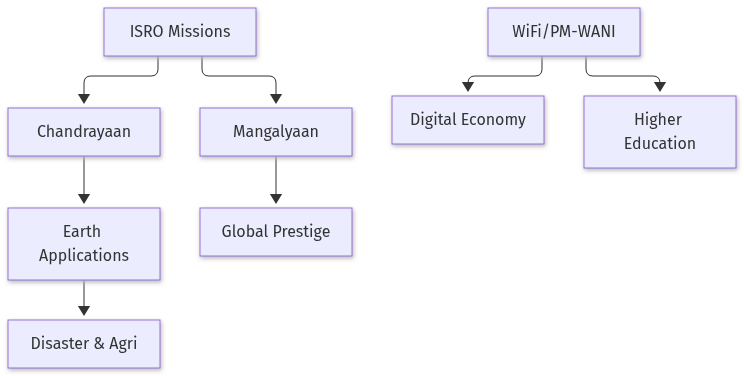
Chandrayaan and Mangalyaan
- Milestones: Chandrayaan-1 (water on Moon discovery), Mangalyaan (Mars orbit first-attempt success), Chandrayaan-3 Vikram lander South Pole soft landing (2023).
- Global significance: Cost-effective engineering, cryogenic and navigation mastery, Artemis Accords signatory diplomacy.
Sectoral Spinoffs
- Agriculture: Remote sensing crop acreage and yield estimation; pest/drought early warning.
- Disaster: Cyclone track prediction, flood extent mapping for NDMA.
- Urban planning: GIS urban sprawl monitoring, smart city dashboards.
WiFi Economy Linkages
- Infrastructure: Public WiFi hotspots under PM-WANI; airport/rail WiFi.
- Economy: Gig platforms, tourism, SME exports via e-commerce.
- Higher education: Campus LMS access, global MOOC participation, research collaborations.
Strategic Balance
- Space inspires STEM pipelines; WiFi democratises knowledge — both need cybersecurity and equitable rural rollout.
Flow diagram
Conclusion
Lunar and Martian successes project India as a credible space power whose earth observation dividends reach farms and cities; ubiquitous WiFi, paired with fibre backhaul, accelerates Viksit Bharat’s human capital and enterprise goals.
Quick related
Students also ask
-
Write short answer of the following questions:
(a) Critically examine the basic structure theory regarding the Indian Constitution.
(b) Is reservation for Economically Weaker Sections (EWS) justified? Comment.
(c) Critically describe about the amendment process of the Indian Constitution.
(d) Explain how Preamble of the Indian Constitution provides a blueprint about the goals of the Constitution.
(e) Describe how caste census is going to influence the politics of Bihar.
Next question on this syllabus topic (2023 · Q1). View answer →
-
How do lunar missions help Indian farmers?
Through improved remote sensing calibration, soil moisture proxies, and disaster mapping pipelines fed by ISRO’s observation fleet.
-
What is PM-WANI?
A framework allowing interoperable public WiFi hotspots delivered by PDOs using reseller models over BharatNet or private backhaul.
More from this topic
Q8 · UPSC Mains 2025 · GS II · 36 marks · Solution
(a) In the perspective of the basics of cyber security, the need for digital sovereignty and the effectiveness of the Prevention of Money Laundering Act (PMLA), suggest components for a comprehensive internal security strategy. Or (b) “The New Indian Space Policy 2023 has opened the floodgates for the private sector.” Is this transition merely about technological development, or has it qualitatively transformed India’s capabilities for national security disaster response and border management? In the context of drone swarm technology, the security of satellite based communication and the strategic significance of GSLV program, propose the essential pillars of a comprehensive ‘Security-Development-Innovation’ strategy for India’s space and allied technologies.
General Studies II
India’s internal security and strategic posture increasingly depend on space-based C4ISR, private innovation under the 2023 Space Policy, and allied technologies (drones, secure satcom, GSLV-class lift) for disaster and border missions.
Q7 · UPSC Mains 2025 · GS II · 36 marks · Solution
Write short answer of the following questions: (See official booklet Section III short notes — cyber security / digital sovereignty / PMLA components and remaining short parts in media/pyq/2025/BPGS2-english.pdf.) In the perspective of the basics of cyber security, the need for digital sovereignty and the effectiveness of the Prevention of Money Laundering Act (PMLA), suggest components for a comprehensive internal security strategy. (Full short-note set: official PDF.)
General Studies II
Internal security in a digital age requires cyber resilience, sovereign control over critical data infrastructure, and anti-money-laundering architecture — PMLA being one pillar among intelligence, policing, and border coordination.
Q6 · UPSC Mains 2025 · GS II · 38 marks · Solution
(a) Discuss the major ports on eastern coast of India. Critically examine the role of Syama Prasad Mookerjee Port, Kolkata (SMPK) in the development of North East India and Bangladesh, giving suitable examples. Or (b) Describe the concept of fourth industrial revolution (Industry 4.0). Critically analyse the biggest benefits and risks of adopting industry 4.0 technologies in India.
General Studies II
Eastern seaboard ports anchor coal, container, and bulk trade for eastern India; SMPK (Kolkata) retains historic hinterland ties to North-East India and Bangladesh via river-sea multimodal networks despite draft limitations.