Revision summary
JEEVIKA organises rural poor women into SHGs, providing credit, livelihoods, and voice — a flagship Bihar empowerment platform linking to PRIs and nutrition missions.
Model answer
Introduction
Bihar Rural Livelihoods Promotion Society (BRLPS) branded JEEVIKA scales NRLM architecture with State-specific innovations.
Body
Introduction
- Entity: BRLPS under Rural Development Department; World Bank assisted phases.
- Coverage: Millions of households via federated SHGs at village/VO/CLF levels.
Objectives
- Social: Organise poor women, build solidarity, leadership.
- Economic: Savings-thrift, bank linkages, livelihood diversification (goatery, kirana, makhana processing).
- Governance: Convergence with Panchayati Raj, nutrition (POSHAN), sanitation.
Women Empowerment Evaluation
- Successes: Increased household income, micro-credit access, women mukhiyas from SHG backgrounds, nutrition behavioural change.
- Challenges: Elite capture in some blocks, market linkage gaps, climate shocks on livestock livelihoods.
- Overall: Among India’s stronger State NRLM implementations.
Flow diagram
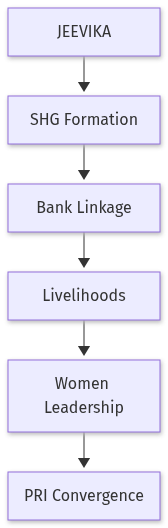
Conclusion
JEEVIKA substantiates the claim that organised women’s collectives can shift Bihar’s rural power dynamics when federations secure fair credit, markets, and PRI entry.
Quick related
Students also ask
-
As per ‘NITI Aayog Health Index, 2021’, Bihar ranks 18th out of 19th larger States of India. List the factors responsible for this pity situation in this State. What steps have been taken to improve health situation in Bihar? Are they sufficient? Support your answer with facts and figures.
Next question on this syllabus topic (2022 · Q7). View answer →
-
What is JEEVIKA’s core method?
Forming women SHGs, training, and federating them for credit and livelihood scale-up.
-
Does JEEVIKA reduce poverty measurably?
Independent assessments show income gains and asset accumulation though impacts vary by district and market access.
More from this topic
Q8 · UPSC Mains 2025 · GS II · 36 marks · Solution
(a) In the perspective of the basics of cyber security, the need for digital sovereignty and the effectiveness of the Prevention of Money Laundering Act (PMLA), suggest components for a comprehensive internal security strategy. Or (b) “The New Indian Space Policy 2023 has opened the floodgates for the private sector.” Is this transition merely about technological development, or has it qualitatively transformed India’s capabilities for national security disaster response and border management? In the context of drone swarm technology, the security of satellite based communication and the strategic significance of GSLV program, propose the essential pillars of a comprehensive ‘Security-Development-Innovation’ strategy for India’s space and allied technologies.
General Studies II
India’s internal security and strategic posture increasingly depend on space-based C4ISR, private innovation under the 2023 Space Policy, and allied technologies (drones, secure satcom, GSLV-class lift) for disaster and border missions.
Q7 · UPSC Mains 2025 · GS II · 36 marks · Solution
Write short answer of the following questions: (See official booklet Section III short notes — cyber security / digital sovereignty / PMLA components and remaining short parts in media/pyq/2025/BPGS2-english.pdf.) In the perspective of the basics of cyber security, the need for digital sovereignty and the effectiveness of the Prevention of Money Laundering Act (PMLA), suggest components for a comprehensive internal security strategy. (Full short-note set: official PDF.)
General Studies II
Internal security in a digital age requires cyber resilience, sovereign control over critical data infrastructure, and anti-money-laundering architecture — PMLA being one pillar among intelligence, policing, and border coordination.
Q6 · UPSC Mains 2025 · GS II · 38 marks · Solution
(a) Discuss the major ports on eastern coast of India. Critically examine the role of Syama Prasad Mookerjee Port, Kolkata (SMPK) in the development of North East India and Bangladesh, giving suitable examples. Or (b) Describe the concept of fourth industrial revolution (Industry 4.0). Critically analyse the biggest benefits and risks of adopting industry 4.0 technologies in India.
General Studies II
Eastern seaboard ports anchor coal, container, and bulk trade for eastern India; SMPK (Kolkata) retains historic hinterland ties to North-East India and Bangladesh via river-sea multimodal networks despite draft limitations.