Revision summary
Regional parties arose from linguistic states, anti-Congress consolidation, and caste-community mobilisation — channelling regional aspirations while mostly operating within national frameworks.
Model answer
Introduction
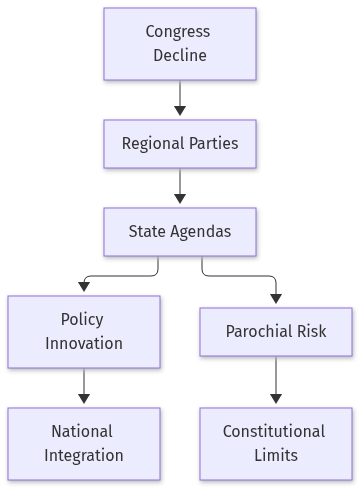
DMK, Shiv Sena (legacy), AGP, BJD, and Bihar’s RJD/JD(U) illustrate regionalisation of party space after Congress decline.
Body
Emergence Factors
- Reorganisation 1956: Language pride parties become ruling parties in states.
- Congress decline post-1989: Vacuum filled by regional satraps with local agendas.
- Caste/community: Mandal and coalitional social bases in Bihar, UP, Tamil Nadu.
Good for Regional Aspirations
- Articulation: Culture, resources, centre neglect voiced powerfully.
- Policy innovation: Kerala education, Tamil Nadu midday meal legacy before national scaling.
- Federal balance: Checks homogenising tendencies.
National Unity Considerations
- Risks: Parochialism, separatist fringe (handled via Article 356 limits post-Bommai).
- Safeguards: National parties coalition with regional allies; shared institutions — army, judiciary, market.
Verdict
- Net positive when regional parties compete within constitutional patriotism; dangerous when exclusivist or secessionist.
Flow diagram
Conclusion
Regional parties democratised India’s party system, letting Bihar-like States negotiate identity and welfare; unity holds when regional success stories integrate nationally rather than isolating.
Quick related
Students also ask
-
An independent judiciary, having the power of ‘judicial review’, is a salient feature of the Constitution of India. Do you think ‘judicial activism’ has further added to the powers of the Supreme Court? Explain with examples.
Next question on this syllabus topic (2022 · Q4). View answer →
-
Are regional parties anti-national?
Generally no — they pursue state-level mandates within the Union except fringe separatist cases.
-
How do they help Bihar?
By centring caste-class issues and bargaining with Centre for resources and schemes.
More from this topic
Q8 · UPSC Mains 2025 · GS II · 36 marks · Solution
(a) In the perspective of the basics of cyber security, the need for digital sovereignty and the effectiveness of the Prevention of Money Laundering Act (PMLA), suggest components for a comprehensive internal security strategy. Or (b) “The New Indian Space Policy 2023 has opened the floodgates for the private sector.” Is this transition merely about technological development, or has it qualitatively transformed India’s capabilities for national security disaster response and border management? In the context of drone swarm technology, the security of satellite based communication and the strategic significance of GSLV program, propose the essential pillars of a comprehensive ‘Security-Development-Innovation’ strategy for India’s space and allied technologies.
General Studies II
India’s internal security and strategic posture increasingly depend on space-based C4ISR, private innovation under the 2023 Space Policy, and allied technologies (drones, secure satcom, GSLV-class lift) for disaster and border missions.
Q7 · UPSC Mains 2025 · GS II · 36 marks · Solution
Write short answer of the following questions: (See official booklet Section III short notes — cyber security / digital sovereignty / PMLA components and remaining short parts in media/pyq/2025/BPGS2-english.pdf.) In the perspective of the basics of cyber security, the need for digital sovereignty and the effectiveness of the Prevention of Money Laundering Act (PMLA), suggest components for a comprehensive internal security strategy. (Full short-note set: official PDF.)
General Studies II
Internal security in a digital age requires cyber resilience, sovereign control over critical data infrastructure, and anti-money-laundering architecture — PMLA being one pillar among intelligence, policing, and border coordination.
Q6 · UPSC Mains 2025 · GS II · 38 marks · Solution
(a) Discuss the major ports on eastern coast of India. Critically examine the role of Syama Prasad Mookerjee Port, Kolkata (SMPK) in the development of North East India and Bangladesh, giving suitable examples. Or (b) Describe the concept of fourth industrial revolution (Industry 4.0). Critically analyse the biggest benefits and risks of adopting industry 4.0 technologies in India.
General Studies II
Eastern seaboard ports anchor coal, container, and bulk trade for eastern India; SMPK (Kolkata) retains historic hinterland ties to North-East India and Bangladesh via river-sea multimodal networks despite draft limitations.