Revision summary
Method-focused WRAP for Section III Table 1: filters female share by department, male neurology-to-cardiology ratio, departments exceeding one-fourth admissions, specialised-care-to-cured ratios, and the stated counterfactual in cardiology — all computed strictly from the printed booklet.
Model answer
Introduction
BPSC data questions reward systematic tabulation; candidates must transcribe the hospital table before applying percentage and ratio formulas.
Body
Source of Truth
- Peg: All numerical answers must be taken from Table 1 (hospital outcomes by department and gender, July 2025) in the official BPSC booklet; marks are awarded for correct computation, not for generic commentary alone.
- Peg: Show ratio answers in lowest terms unless the paper asks for a decimal; label gender or state filters before calculating percentages.
Female Share by Department
- Peg: For each department row, compute female patients ÷ total patients × 100; compare shares, not absolute counts.
- Peg: The department with the maximum percentage among females wins part (a); tie-break using booklet order if stated.
Male Neurology : Cardiology Ratio
- Peg: Restrict to male column only; ratio = Neurology male count : Cardiology male count in lowest terms.
- Peg: State answer as a : b after dividing both by HCF.
Departments Above One-Fourth of Admissions
- Peg: For each gender separately, total admissions = sum of department rows under that gender.
- Peg: Mark departments where count > ¼ × gender total; list all qualifiers for part (c).
Specialised Care to Cured Ratio
- Peg: For combined male+female group, compute (specialised care total) ÷ (cured total) per department.
- Peg: Highest ratio department answers part (d); show intermediate fractions before decimal if needed.
Counterfactual Adjustment — Cardiology
- Peg: Apply stem change: +1 female specialised care, +1 female cured, −1 male cured in Cardiology only.
- Peg: Recompute specialised-care-to-cured ratio separately for each gender after adjustment; report both.
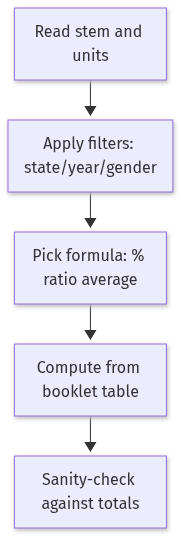
Flow diagram
Conclusion
Hospital-table items test filtering discipline; write gender subtotals first, then apply each sub-question formula to avoid mixed denominators — the usual BPSC Section III error.
Quick related
Students also ask
-
Section III statistical / graph / diagram question continuing from the official booklet (Fig. 1 persons aged 60+ by gender and residence, and remaining sub-questions). See media/pyq/2025/BPGS1-english.pdf for the printed figures and full sub-parts.
Next question on this syllabus topic (2025 · Q8). View answer →
-
Can I answer without the official table?
No — numerical marks require values from the BPSC booklet PDF; this WRAP teaches method, not substitute numbers.
-
Should ratios be decimal or fractional?
Use lowest-term ratios when the question asks for ratio; decimals only if the stem specifies.
More from this topic
Q8 · UPSC Mains 2025 · GS I · 36 marks · Solution
Section III statistical / graph / diagram question continuing from the official booklet (Fig. 1 persons aged 60+ by gender and residence, and remaining sub-questions). See media/pyq/2025/BPGS1-english.pdf for the printed figures and full sub-parts.
General Studies I
Fig. 1 items typically combine bar or pie readings on elderly population by gender and rural–urban residence; approach mirrors percentage change, share comparison, and dual-filter reading.
Q6 · UPSC Mains 2025 · GS I · 38 marks · Solution
(a) In recent years, the Chhath festival has gained increasing global attention. Discuss the Social, cultural and economic impact of Chhath and its linkages with migration. Or (b) Bihar has emerged as the top-performing state in the country in the ‘Prime Minister Formalization Micro Food Processing Enterprises Upgradation’ (PMFME) Scheme. Analyse the potential PMFME towards contribution in the economic development of the Urban and Rural areas in Bihar.
General Studies I
Chhath is a lunar festival venerating Surya and Chhathi Maiya, concentrated in Bihar–Purvanchal; diaspora celebration, reverse migration, and local informal economy effects make it a transnational cultural asset with measurable remittance and tourism spillovers.
Q5 · UPSC Mains 2025 · GS I · 38 marks · Solution
(a) Discuss the India-European Free Trade Association (EFTA) Trade and Economic Partnership Agreement (TEPA), signed on 10 March 2024, which came into effect on 1 October 2025. Also, explain the economic and strategic implications of India-EU relations. Or (b) The UN Sustainable Development Goals (SDGs), also known as the Global Goals, have been in effect for ten years since their adoption in September 2015. Examine India's progress and challenges in achieving the United Nations' Sustainable Development Goals.
General Studies I
TEPA with Iceland, Liechtenstein, Norway, and Switzerland trades market access for a binding USD 100 billion investment and jobs pledge over 15 years, while India–EU ties pivot on FTA talks, green partnership, and strategic autonomy amid China–Russia stress.