Revision summary
This BPSC Mains answer set covers key contemporary issues including WHO drug safety concerns in India's pharma sector, the decentralized push of Adi Karmayogi Abhiyan and Tribal Village Vision 2030, the balance in the Online Gaming Bill 2025 between e-sports promotion and youth protection, global anti-immigration surges, and the strategic resetting of India-Afghanistan relations. Each segment follows strict examiner-facing architecture with structured sub-heads, precise policy anchors, and a synthesis closing.
Model answer
Introduction
Contemporary governance, global public health standards, shifting geopolitical alignments, and domestic welfare frameworks require robust regulatory architecture and decentralised administrative outreach. Addressing critical gaps in pharmaceutical oversight, empowering tribal grassroots governance, regulating digital gaming economies, managing global migration pressures, and recalibrating strategic neighbourhood diplomacy constitute essential imperatives for India's national interest and developmental trajectory.
Body
WHO Drug Safety Concerns
World Health Organization alerts regarding substandard cough syrups highlight critical vulnerabilities in India's pharmaceutical export quality control mechanisms.
- Peg: WHO issued multiple medical product alerts regarding contaminated syrups linked to pediatric fatalities globally.
- Peg: Regulatory fragmentation between Central Drugs Standard Control Organization (CDSCO) and State Licensing Authorities creates inconsistent manufacturing standards.
- Peg: Need for mandatory Good Manufacturing Practices (GMP) compliance and stringent supply chain traceability for Active Pharmaceutical Ingredients (APIs).
Decentralisation via Tribal Initiatives
Adi Karmayogi Abhiyan and the Tribal Village Vision 2030 Declaration serve as vital instruments for deepening grassroots democracy and administrative autonomy in Scheduled Areas.
- Peg: Adi Karmayogi Abhiyan focuses on capacity building and leadership development of local tribal functionaries to improve last-mile delivery.
- Peg: Tribal Village Vision 2030 aligns local development plans with culturally sensitive, bottom-up resource allocation.
- Peg: Reinforces the Panchayats (Extension to the Scheduled Areas) Act, 1996 (PESA) by institutionalising community-led planning.
Online Gaming Regulation
The Promotion and Regulation of Online Gaming Bill, 2025 establishes a comprehensive framework to balance digital economy growth with societal protection.
- Peg: Provides statutory recognition and promotional incentives for legitimate e-sports and skill-based online social games.
- Peg: Establishes a central regulatory authority to curb predatory financial fraud, money laundering, and addictive gambling mechanics.
- Peg: Implements robust age-verification protocols and protective guardrails to shield youth from psychological harms and cyber frauds.
Global Anti-Immigration Surge
Socio-economic anxieties and security pressures have fueled an unprecedented rise in anti-immigration rhetoric, restrictive policy shifts, and social protests across Western democracies and Asian states.
- Peg: Western nations face rising political polarisation driven by asylum backlogs, economic strains, and cultural integration debates.
- Peg: Parts of Asia implement stringent border controls and labor repatriation policies due to domestic job market pressures and national security concerns.
- Peg: This global shift impacts diaspora mobility, remittance flows, and bilateral diplomatic engagements regarding legal migration corridors.
India-Afghanistan Strategic Reset
Recent diplomatic engagements, including the high-level visit of the Afghan foreign minister, mark a pragmatic recalibration of India's engagement with Kabul.
- Peg: Focuses on humanitarian assistance, medical supplies, and developmental project completions without formal regime recognition.
- Peg: Addresses critical regional security concerns, counter-terrorism cooperation, and connectivity imperatives through Chabahar Port.
- Peg: Balances India's historical goodwill with the Afghan populace against realistic geopolitical calculations in Central-South Asia.
Flow diagram
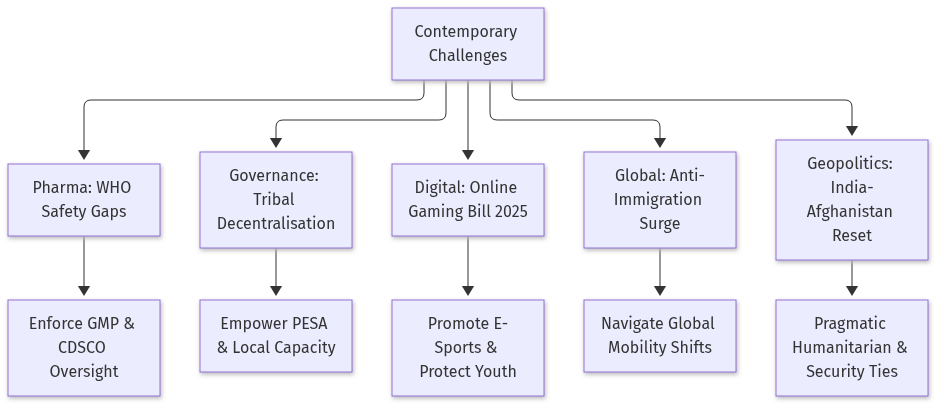
Conclusion
Addressing these multifaceted domestic and international challenges demands a calibrated synthesis of rigorous regulation, inclusive governance, and pragmatic diplomacy. While strengthening domestic institutional integrity—from drug safety to digital economies—protects citizen welfare, proactive strategic engagements ensure India remains resilient amidst shifting global paradigms.
Quick related
Students also ask
-
(a) Discuss the India-European Free Trade Association (EFTA) Trade and Economic Partnership Agreement (TEPA), signed on 10 March 2024, which came into effect on 1 October 2025. Also, explain the economic and strategic implications of India-EU relations.
Or
(b) The UN Sustainable Development Goals (SDGs), also known as the Global Goals, have been in effect for ten years since their adoption in September 2015. Examine India's progress and challenges in achieving the United Nations' Sustainable Development Goals.
Next question on this syllabus topic (2025 · Q5). View answer →
-
What are the primary concerns raised by the WHO regarding India's pharmaceutical sector?
The WHO has raised concerns over manufacturing standards, quality control gaps, and regulatory fragmentation between central and state authorities leading to the export of substandard medical products.
-
How do Adi Karmayogi Abhiyan and Tribal Village Vision 2030 aid decentralisation?
They promote grassroots capacity building, empower local tribal leadership, and institutionalise bottom-up developmental planning aligned with constitutional provisions like PESA.
More from this topic
Q8 · UPSC Mains 2025 · GS I · 36 marks · Solution
Section III statistical / graph / diagram question continuing from the official booklet (Fig. 1 persons aged 60+ by gender and residence, and remaining sub-questions). See media/pyq/2025/BPGS1-english.pdf for the printed figures and full sub-parts.
General Studies I
Fig. 1 items typically combine bar or pie readings on elderly population by gender and rural–urban residence; approach mirrors percentage change, share comparison, and dual-filter reading.
Q7 · UPSC Mains 2025 · GS I · 36 marks · Solution
In respect of hospital data given in Table 1, answer the following questions. (Table in official booklet — July 2025 hospital outcome data by department and gender.) (a) Which department has highest percentage of female patients? (b) What is ratio of Neurology patients to Cardiology patients among male patients? (c) Which departments have more than one-fourth of the total admissions, respectively in each gender category? (d) Which department has highest ratio of specialized care to cured ratio for male and female combined group? (e) If one more female was admitted to specialized care and cured category each and one less male under cured category in the Cardiology department, then what would be the overall ratios of specialized care to cured under each gender? Or In respect of data from Fig. 1 for population aged above 60, answer the questions that follow. (Figure in official booklet.)
General Studies I
Method-focused WRAP for Section III Table 1: filters female share by department, male neurology-to-cardiology ratio, departments exceeding one-fourth admissions, specialised-care-to-cured ratios, and the stated counterfactual in cardiology — all computed strictly from the printed booklet.
Q6 · UPSC Mains 2025 · GS I · 38 marks · Solution
(a) In recent years, the Chhath festival has gained increasing global attention. Discuss the Social, cultural and economic impact of Chhath and its linkages with migration. Or (b) Bihar has emerged as the top-performing state in the country in the ‘Prime Minister Formalization Micro Food Processing Enterprises Upgradation’ (PMFME) Scheme. Analyse the potential PMFME towards contribution in the economic development of the Urban and Rural areas in Bihar.
General Studies I
Chhath is a lunar festival venerating Surya and Chhathi Maiya, concentrated in Bihar–Purvanchal; diaspora celebration, reverse migration, and local informal economy effects make it a transnational cultural asset with measurable remittance and tourism spillovers.