Revision summary
Missionary, government, and zamindar initiatives created an Anglicised middle class in Patna–Bhagalpur, feeding nationalism, communal journalism, and technical institutions.
Model answer
Introduction
Western education in Bihar followed colonial utility logic yet produced unintended nationalist and reformist energies.
Body
Colonial Policy and Early Institutions
- Peg: Wood's Despatch (1854) frame; Patna College (1863), collegiate schools, and survey/settlement bureaucracies needed literate staff.
- Peg: Mission schools (Anglican, Methodist) and Hindu–Muslim voluntary societies spread English alongside Urdu and Hindi.
Social Composition of Learners
- Peg: Bhumihars, Kayasthas, Bengali migrants, and Muslim gentry dominated early intake; lower castes accessed vernacular paths later.
- Peg: Gender access widened with Bethune lineage schools and reformist trusts.
Press, Politics, and Reform
- Peg: Newspapers in Hindi, Urdu, and English debated tenancy, cow protection, and council reforms.
- Peg: Alumni joined Congress, Muslim League, and socialist groups; lawyers led Champaran and Non-Cooperation.
Technical and Professional Streams
- Peg: Engineering and medical colleges (later Bihar University system) aligned with railways and industries on coal–steel corridor.
- Peg: Tension between classical Orientalism and utilitarian curricula persisted.
Critique and Vernacular Revival
- Peg: Gandhi's critique of colonial education resonated; Hindi Sahitya Sammelan and Muslim literary societies asserted cultural autonomy.
- Peg: Education expansion without mass literacy left Bihar with elite-led nationalism.
Flow diagram
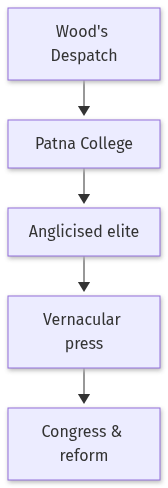
Conclusion
Western education in Bihar produced a bilingual elite that powered provincial nationalism while leaving structural literacy gaps for post-independence policy.
Quick related
Students also ask
-
Answer the following questions:
(a) Discuss the direction of unity and coalition politics of opposition parties after the defeat of Aam Aadmi Party in Delhi Assembly Elections, 2025.
(b) Russia-Ukraine war has completed three years. Throwing light on the causes of this war, discuss its effects on the World politics.
(c) Maha Kumbh Fair was organized in India from Monday, 13 January, 2025 to 26 February, 2025. How was this fair a symbol of Indian culture, religious faith and social harmony? Explain with examples.
(d) Throw detailed light on the need and importance of caste based Census in Bihar.
(e) Analyze logically what the future of the United States of America will be at national and international level under the leadership of newly elected President Donald Trump.
Next question on this syllabus topic (2024 · Q4). View answer →
-
Did Western education directly cause nationalism in Bihar?
It supplied tools and networks; economic grievances and charismatic leadership translated education into political action.
-
What languages dominated Bihar's schools?
English at collegiate level with parallel Hindi and Urdu public spheres.
More from this topic
Q8 · UPSC Mains 2025 · GS I · 36 marks · Solution
Section III statistical / graph / diagram question continuing from the official booklet (Fig. 1 persons aged 60+ by gender and residence, and remaining sub-questions). See media/pyq/2025/BPGS1-english.pdf for the printed figures and full sub-parts.
General Studies I
Fig. 1 items typically combine bar or pie readings on elderly population by gender and rural–urban residence; approach mirrors percentage change, share comparison, and dual-filter reading.
Q7 · UPSC Mains 2025 · GS I · 36 marks · Solution
In respect of hospital data given in Table 1, answer the following questions. (Table in official booklet — July 2025 hospital outcome data by department and gender.) (a) Which department has highest percentage of female patients? (b) What is ratio of Neurology patients to Cardiology patients among male patients? (c) Which departments have more than one-fourth of the total admissions, respectively in each gender category? (d) Which department has highest ratio of specialized care to cured ratio for male and female combined group? (e) If one more female was admitted to specialized care and cured category each and one less male under cured category in the Cardiology department, then what would be the overall ratios of specialized care to cured under each gender? Or In respect of data from Fig. 1 for population aged above 60, answer the questions that follow. (Figure in official booklet.)
General Studies I
Method-focused WRAP for Section III Table 1: filters female share by department, male neurology-to-cardiology ratio, departments exceeding one-fourth admissions, specialised-care-to-cured ratios, and the stated counterfactual in cardiology — all computed strictly from the printed booklet.
Q6 · UPSC Mains 2025 · GS I · 38 marks · Solution
(a) In recent years, the Chhath festival has gained increasing global attention. Discuss the Social, cultural and economic impact of Chhath and its linkages with migration. Or (b) Bihar has emerged as the top-performing state in the country in the ‘Prime Minister Formalization Micro Food Processing Enterprises Upgradation’ (PMFME) Scheme. Analyse the potential PMFME towards contribution in the economic development of the Urban and Rural areas in Bihar.
General Studies I
Chhath is a lunar festival venerating Surya and Chhathi Maiya, concentrated in Bihar–Purvanchal; diaspora celebration, reverse migration, and local informal economy effects make it a transnational cultural asset with measurable remittance and tourism spillovers.