Revision summary
Gandhi’s first rural satyagraha in 1917 against tinkathia indigo system mobilised peasants, linked agrarian Bihar to national leadership, and validated truth-force tactics.
Model answer
Introduction
Champaran transformed Indian nationalism from urban elite politics to peasant-backed satyagraha under Gandhi.
Body
Background in Champaran
- Peg: European planters enforced tinkathia (3/20 land for indigo); peasants faced coercion and penal contracts.
- Peg: Rajkumar Shukla persuaded Gandhi to investigate; arrival April 1917 tested colonial permission to enter disturbed district.
Course of Satyagraha
- Peg: Gandhi investigated villages, recorded testimonies, trained local volunteers (Rajendra Prasad, J.B. Kripalani, Brajkishore Prasad).
- Peg: Defied ban orders; court appearance became moral spectacle; government conceded inquiry committee.
Settlement and Outcomes
- Peg: Champaran Agrarian Act 1918 abolished tinkathia; partial relief on compensation disputes.
- Peg: Established Gandhi as mass leader; methodology of enquiry–publicity–nonviolent pressure codified.
Impact on Freedom Struggle
- Peg: Bridge to Kheda and Ahmedabad; demonstrated Hindu–Muslim–peasant unity in Bihar.
- Peg: Legitimised constructive programme and village tours for Congress organisation.
- Peg: Inspired later peasant movements (Kisan Sabha) linking class and nation questions.
Flow diagram
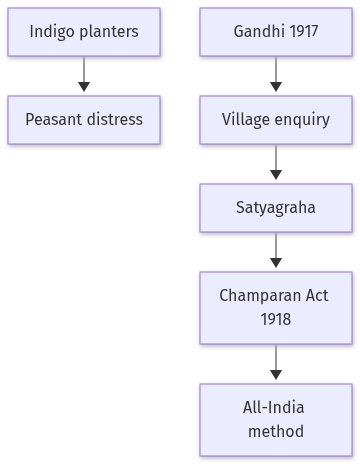
Conclusion
Champaran is the template for Gandhian politics — fact-finding, moral legitimacy, and state negotiation — with Bihar as its birthplace.
Quick related
Students also ask
-
(a) Examine the expansion of Western Education in Bihar from mid-nineteenth century onward.
Or
(b) Assess the constructive works of Mahatma Gandhi.
Next question on this syllabus topic (2024 · Q3). View answer →
-
Was Champaran Gandhi's first satyagraha in India?
It was his first major rural satyagraha on Indian soil after South African experience.
-
How did it affect Congress?
It shifted strategy toward mass rural mobilisation and validated Gandhi's leadership nationally.
More from this topic
Q8 · UPSC Mains 2025 · GS I · 36 marks · Solution
Section III statistical / graph / diagram question continuing from the official booklet (Fig. 1 persons aged 60+ by gender and residence, and remaining sub-questions). See media/pyq/2025/BPGS1-english.pdf for the printed figures and full sub-parts.
General Studies I
Fig. 1 items typically combine bar or pie readings on elderly population by gender and rural–urban residence; approach mirrors percentage change, share comparison, and dual-filter reading.
Q7 · UPSC Mains 2025 · GS I · 36 marks · Solution
In respect of hospital data given in Table 1, answer the following questions. (Table in official booklet — July 2025 hospital outcome data by department and gender.) (a) Which department has highest percentage of female patients? (b) What is ratio of Neurology patients to Cardiology patients among male patients? (c) Which departments have more than one-fourth of the total admissions, respectively in each gender category? (d) Which department has highest ratio of specialized care to cured ratio for male and female combined group? (e) If one more female was admitted to specialized care and cured category each and one less male under cured category in the Cardiology department, then what would be the overall ratios of specialized care to cured under each gender? Or In respect of data from Fig. 1 for population aged above 60, answer the questions that follow. (Figure in official booklet.)
General Studies I
Method-focused WRAP for Section III Table 1: filters female share by department, male neurology-to-cardiology ratio, departments exceeding one-fourth admissions, specialised-care-to-cured ratios, and the stated counterfactual in cardiology — all computed strictly from the printed booklet.
Q6 · UPSC Mains 2025 · GS I · 38 marks · Solution
(a) In recent years, the Chhath festival has gained increasing global attention. Discuss the Social, cultural and economic impact of Chhath and its linkages with migration. Or (b) Bihar has emerged as the top-performing state in the country in the ‘Prime Minister Formalization Micro Food Processing Enterprises Upgradation’ (PMFME) Scheme. Analyse the potential PMFME towards contribution in the economic development of the Urban and Rural areas in Bihar.
General Studies I
Chhath is a lunar festival venerating Surya and Chhathi Maiya, concentrated in Bihar–Purvanchal; diaspora celebration, reverse migration, and local informal economy effects make it a transnational cultural asset with measurable remittance and tourism spillovers.