Revision summary
Colonial colleges, engineering pathways, and university consolidation created bureaucracy-feeding elites and nationalist cadres.
Model answer
Introduction
Education expansion tracked provincial autonomy and industrial estates on coal belt.
Body
Mid-Nineteenth Beginnings
- Peg: Patna College, missionary schools, survey training for revenue bureaucracy.
Technical Streams
- Peg: Engineering institutions linked to railways, irrigation, and mining; Bihar School of Engineering lineage.
- Peg: Medical and law colleges supplied provincial services.
Political Effects
- Peg: Graduates led Champaran, peasant unions, and Quit India networks.
Limits
- Peg: Rural literacy and girls' schooling remained constrained; dropouts to informal labour persisted.
Flow diagram
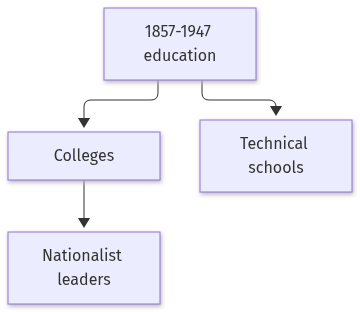
Conclusion
Western–technical education professionalised a thin elite layer while mass illiteracy shaped Bihar's post-1947 development challenge.
Quick related
Students also ask
-
Critically analyze the factors responsible for the emergence of Gandhiji as an eminent nationalist leader.
Next question on this syllabus topic (2022 · Q3). View answer →
-
Technical vs liberal education?
Technical streams fed colonial infrastructure jobs; liberal arts fed law and politics.
More from this topic
Q8 · UPSC Mains 2025 · GS I · 36 marks · Solution
Section III statistical / graph / diagram question continuing from the official booklet (Fig. 1 persons aged 60+ by gender and residence, and remaining sub-questions). See media/pyq/2025/BPGS1-english.pdf for the printed figures and full sub-parts.
General Studies I
Fig. 1 items typically combine bar or pie readings on elderly population by gender and rural–urban residence; approach mirrors percentage change, share comparison, and dual-filter reading.
Q7 · UPSC Mains 2025 · GS I · 36 marks · Solution
In respect of hospital data given in Table 1, answer the following questions. (Table in official booklet — July 2025 hospital outcome data by department and gender.) (a) Which department has highest percentage of female patients? (b) What is ratio of Neurology patients to Cardiology patients among male patients? (c) Which departments have more than one-fourth of the total admissions, respectively in each gender category? (d) Which department has highest ratio of specialized care to cured ratio for male and female combined group? (e) If one more female was admitted to specialized care and cured category each and one less male under cured category in the Cardiology department, then what would be the overall ratios of specialized care to cured under each gender? Or In respect of data from Fig. 1 for population aged above 60, answer the questions that follow. (Figure in official booklet.)
General Studies I
Method-focused WRAP for Section III Table 1: filters female share by department, male neurology-to-cardiology ratio, departments exceeding one-fourth admissions, specialised-care-to-cured ratios, and the stated counterfactual in cardiology — all computed strictly from the printed booklet.
Q6 · UPSC Mains 2025 · GS I · 38 marks · Solution
(a) In recent years, the Chhath festival has gained increasing global attention. Discuss the Social, cultural and economic impact of Chhath and its linkages with migration. Or (b) Bihar has emerged as the top-performing state in the country in the ‘Prime Minister Formalization Micro Food Processing Enterprises Upgradation’ (PMFME) Scheme. Analyse the potential PMFME towards contribution in the economic development of the Urban and Rural areas in Bihar.
General Studies I
Chhath is a lunar festival venerating Surya and Chhathi Maiya, concentrated in Bihar–Purvanchal; diaspora celebration, reverse migration, and local informal economy effects make it a transnational cultural asset with measurable remittance and tourism spillovers.