Revision summary
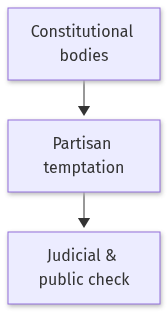
Balanced view: temptation to partisan use exists across regimes; judiciary and EC partially check misuse; reforms needed.
Model answer
Introduction
Allegations target governor, ED, CBI, media capture — normative stakes high.
Body
Institutional Framers' Intent
- Peg: Independent EC, judiciary, CAG, UPSC meant insulation via tenure and procedure.
Alleged Misuse Patterns
- Peg: Governor invitations in hung assemblies; central agencies in opposition-led states; ordinance route bypassing legislatures.
- Peg: Not exclusive to one party — historical precedents under Congress and coalition eras too.
Safeguards and Gaps
- Peg: Judicial review (Bommai), RTI (weakened areas), civil society vigilance.
- Peg: Need: fixed governor terms, administrative federalism norms, bipartisan appointments.
Conclusion Frame
- Peg: Partial agreement — incentives favour misuse but institutions retain corrective capacity when public scrutiny strong.
Flow diagram
Conclusion
Democratic health requires depoliticising appointments and strengthening transparency — accusation applies opportunistically but systemic risk is real.
Quick related
Students also ask
-
Study the following table carefully and answer the questions given below: Percentage marks obtained by seven students in six different subjects. (Table in official booklet.)
(a) Find the total percentage marks secured by R in all the six subjects together.
(b) Find the difference between the marks obtained by P in the subjects B, D and E together and the marks obtained by T in the same subjects.
(c) Find the average marks obtained by all the students in the subject B.
(d) Find the average percent of marks obtained by all the students in the subjects C and D together.
(e) What is the total marks obtained by all the students in subject F?
Next question on this syllabus topic (2022 · Q12). View answer →
-
Is EC fully independent?
Designed to be; perceived neutrality tested during heated national elections.
More from this topic
Q8 · UPSC Mains 2025 · GS I · 36 marks · Solution
Section III statistical / graph / diagram question continuing from the official booklet (Fig. 1 persons aged 60+ by gender and residence, and remaining sub-questions). See media/pyq/2025/BPGS1-english.pdf for the printed figures and full sub-parts.
General Studies I
Fig. 1 items typically combine bar or pie readings on elderly population by gender and rural–urban residence; approach mirrors percentage change, share comparison, and dual-filter reading.
Q7 · UPSC Mains 2025 · GS I · 36 marks · Solution
In respect of hospital data given in Table 1, answer the following questions. (Table in official booklet — July 2025 hospital outcome data by department and gender.) (a) Which department has highest percentage of female patients? (b) What is ratio of Neurology patients to Cardiology patients among male patients? (c) Which departments have more than one-fourth of the total admissions, respectively in each gender category? (d) Which department has highest ratio of specialized care to cured ratio for male and female combined group? (e) If one more female was admitted to specialized care and cured category each and one less male under cured category in the Cardiology department, then what would be the overall ratios of specialized care to cured under each gender? Or In respect of data from Fig. 1 for population aged above 60, answer the questions that follow. (Figure in official booklet.)
General Studies I
Method-focused WRAP for Section III Table 1: filters female share by department, male neurology-to-cardiology ratio, departments exceeding one-fourth admissions, specialised-care-to-cured ratios, and the stated counterfactual in cardiology — all computed strictly from the printed booklet.
Q6 · UPSC Mains 2025 · GS I · 38 marks · Solution
(a) In recent years, the Chhath festival has gained increasing global attention. Discuss the Social, cultural and economic impact of Chhath and its linkages with migration. Or (b) Bihar has emerged as the top-performing state in the country in the ‘Prime Minister Formalization Micro Food Processing Enterprises Upgradation’ (PMFME) Scheme. Analyse the potential PMFME towards contribution in the economic development of the Urban and Rural areas in Bihar.
General Studies I
Chhath is a lunar festival venerating Surya and Chhathi Maiya, concentrated in Bihar–Purvanchal; diaspora celebration, reverse migration, and local informal economy effects make it a transnational cultural asset with measurable remittance and tourism spillovers.