Revision summary
All-India nationalist platform emerged from associations, press, and educated elite grievances; British combined concession and repression.
Model answer
Introduction
Congress founded 1885 amid provincial associations and moderate constitutionalism.
Body
Factors for Congress Formation
- Peg: All-India personnel needs of British administration; Vernacular Press Act backlash united editors.
- Peg: Ilbert controversy, famine relief critique, and Indian National Conference precedents.
- Peg: Allan Octavian Hume's facilitating role and safety valve debate notwithstanding elite consensus for unified platform.
Early British Policies
- Peg: Councils Acts 1861/1892 incrementalism; Civil Service competitive exam after 1853 opened limited Indian entry.
- Peg: Repression via Arms Act, Vernacular Press Act, and divided Bengal (1905) radicalised opposition.
- Peg: Pseudo-reforms and sedition laws alternated with co-option of moderates.
Flow diagram
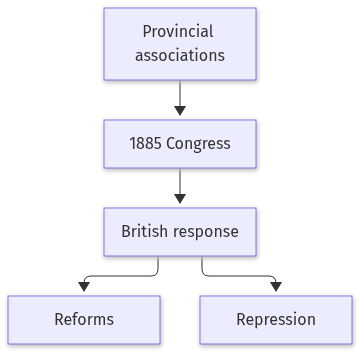
Conclusion
Congress was product of structural colonial modernity; British policies oscillated between divide, reward moderates, and punish radicals.
Quick related
Students also ask
-
Trace the course of expansion of Western and technical education in Bihar between 1857–1947.
Next question on this syllabus topic (2022 · Q2). View answer →
-
Was Congress a British plot?
Historians reject pure safety-valve view; Indian elite agency was decisive.
-
Early nationalist methods?
Petitions, legal agitation, economic critique, limited mass base initially.
More from this topic
Q8 · UPSC Mains 2025 · GS I · 36 marks · Solution
Section III statistical / graph / diagram question continuing from the official booklet (Fig. 1 persons aged 60+ by gender and residence, and remaining sub-questions). See media/pyq/2025/BPGS1-english.pdf for the printed figures and full sub-parts.
General Studies I
Fig. 1 items typically combine bar or pie readings on elderly population by gender and rural–urban residence; approach mirrors percentage change, share comparison, and dual-filter reading.
Q7 · UPSC Mains 2025 · GS I · 36 marks · Solution
In respect of hospital data given in Table 1, answer the following questions. (Table in official booklet — July 2025 hospital outcome data by department and gender.) (a) Which department has highest percentage of female patients? (b) What is ratio of Neurology patients to Cardiology patients among male patients? (c) Which departments have more than one-fourth of the total admissions, respectively in each gender category? (d) Which department has highest ratio of specialized care to cured ratio for male and female combined group? (e) If one more female was admitted to specialized care and cured category each and one less male under cured category in the Cardiology department, then what would be the overall ratios of specialized care to cured under each gender? Or In respect of data from Fig. 1 for population aged above 60, answer the questions that follow. (Figure in official booklet.)
General Studies I
Method-focused WRAP for Section III Table 1: filters female share by department, male neurology-to-cardiology ratio, departments exceeding one-fourth admissions, specialised-care-to-cured ratios, and the stated counterfactual in cardiology — all computed strictly from the printed booklet.
Q6 · UPSC Mains 2025 · GS I · 38 marks · Solution
(a) In recent years, the Chhath festival has gained increasing global attention. Discuss the Social, cultural and economic impact of Chhath and its linkages with migration. Or (b) Bihar has emerged as the top-performing state in the country in the ‘Prime Minister Formalization Micro Food Processing Enterprises Upgradation’ (PMFME) Scheme. Analyse the potential PMFME towards contribution in the economic development of the Urban and Rural areas in Bihar.
General Studies I
Chhath is a lunar festival venerating Surya and Chhathi Maiya, concentrated in Bihar–Purvanchal; diaspora celebration, reverse migration, and local informal economy effects make it a transnational cultural asset with measurable remittance and tourism spillovers.