Revision summary
Internal security in a digital age requires cyber resilience, sovereign control over critical data infrastructure, and anti-money-laundering architecture — PMLA being one pillar among intelligence, policing, and border coordination.
Model answer
Introduction
Section III short notes converge on how networked crime, cross-border finance, and data flows challenge classical policing, demanding integrated doctrine from CERT-In to FIU-IND.
Body
Cyber Security Basics
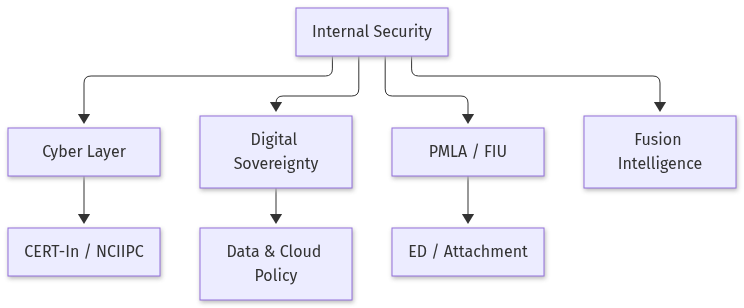
- Layers: Identify–protect–detect–respond–recover (NIST-aligned); critical infrastructure protection for power, telecom, banking.
- Institutions: CERT-In, National Critical Information Infrastructure Protection Centre (NCIIPC), sectoral CERTs; IT Act Sections 43–47, 66, 70B.
- Threats: Ransomware, supply-chain attacks, phishing, state-sponsored intrusions.
Digital Sovereignty
- Meaning: Jurisdiction over data, standards, and core internet governance; reducing dependency on foreign clouds for sensitive workloads.
- Measures: Data localisation guidelines for finance/health, indigenous 5G stack, encryption policy, sovereign cloud for government workloads.
PMLA Effectiveness
- Components: Designated offences, attachment/adjudication, FIU-IND suspicious transaction reporting, ED investigation, international cooperation (FATF).
- Strengths: Deters terror finance and hawala layering; weaknesses include backlog, definitional overbreadth, and due-process debates.
Comprehensive Internal Security Strategy
- Fusion centres: State–Centre intelligence sharing (MAC, SIBs).
- Border tech: CIBMS, coastal radar, drone surveillance.
- Counter-radicalisation: Community policing, CVE programmes.
- Cyber-financial nexus: Joint FIU–CERT protocols; real-time wallet tracing.
- Capacity: NSG, CAPF modernization, state ATS upskilling.
Flow diagram
Conclusion
A modern internal security strategy must treat cyberspace as a domain of war and crime, assert calibrated digital sovereignty, and deploy PMLA-FIU architecture alongside kinetic border management — unified under national intelligence fusion and accountable civil liberties safeguards.
Quick related
Students also ask
-
(a) In the perspective of the basics of cyber security, the need for digital sovereignty and the effectiveness of the Prevention of Money Laundering Act (PMLA), suggest components for a comprehensive internal security strategy.
Or
(b) “The New Indian Space Policy 2023 has opened the floodgates for the private sector.” Is this transition merely about technological development, or has it qualitatively transformed India’s capabilities for national security disaster response and border management? In the context of drone swarm technology, the security of satellite based communication and the strategic significance of GSLV program, propose the essential pillars of a comprehensive ‘Security-Development-Innovation’ strategy for India’s space and allied technologies.
Next question on this syllabus topic (2025 · Q8). View answer →
-
What is digital sovereignty in security terms?
State capacity to govern data flows, host sensitive workloads, and set standards without excessive foreign dependency for critical sectors.
-
How does PMLA support internal security?
By criminalising money laundering, enabling attachment of proceeds, and linking banks to FIU-IND for terror and organised crime finance detection.
More from this topic
Q8 · UPSC Mains 2025 · GS II · 36 marks · Solution
(a) In the perspective of the basics of cyber security, the need for digital sovereignty and the effectiveness of the Prevention of Money Laundering Act (PMLA), suggest components for a comprehensive internal security strategy. Or (b) “The New Indian Space Policy 2023 has opened the floodgates for the private sector.” Is this transition merely about technological development, or has it qualitatively transformed India’s capabilities for national security disaster response and border management? In the context of drone swarm technology, the security of satellite based communication and the strategic significance of GSLV program, propose the essential pillars of a comprehensive ‘Security-Development-Innovation’ strategy for India’s space and allied technologies.
General Studies II
India’s internal security and strategic posture increasingly depend on space-based C4ISR, private innovation under the 2023 Space Policy, and allied technologies (drones, secure satcom, GSLV-class lift) for disaster and border missions.
Q6 · UPSC Mains 2025 · GS II · 38 marks · Solution
(a) Discuss the major ports on eastern coast of India. Critically examine the role of Syama Prasad Mookerjee Port, Kolkata (SMPK) in the development of North East India and Bangladesh, giving suitable examples. Or (b) Describe the concept of fourth industrial revolution (Industry 4.0). Critically analyse the biggest benefits and risks of adopting industry 4.0 technologies in India.
General Studies II
Eastern seaboard ports anchor coal, container, and bulk trade for eastern India; SMPK (Kolkata) retains historic hinterland ties to North-East India and Bangladesh via river-sea multimodal networks despite draft limitations.
Q5 · UPSC Mains 2025 · GS II · 38 marks · Solution
(a) Discuss the role of railway in the development of country. Critically analyze the geographical, economic and political challenges faced by Indian Railways in enhancing its logistics efficiency in north-eastern part of country? Or (b) What are the components of food security? How far hydroponic agriculture will be helpful to fulfil the future domestic demands in country? Justify it with suitable examples.
General Studies II
Indian Railways is the backbone of bulk freight and long-distance mobility, yet North-Eastern connectivity faces terrain, geopolitical, and capacity constraints that raise logistics costs and slow integration with the mainland economy.