Revision summary
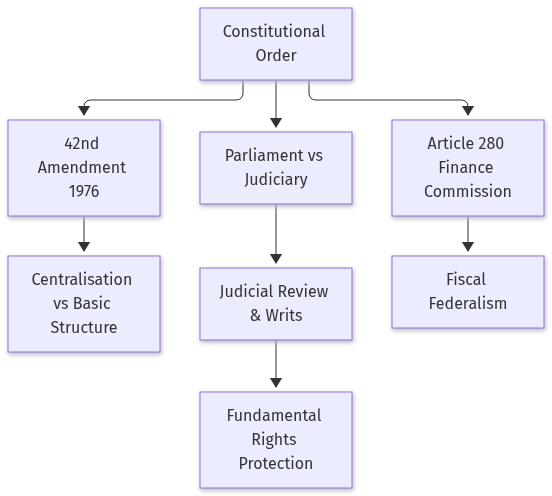
This composite short-answer set covers the 42nd Amendment’s centralising thrust, the settled framework of constitutional supremacy with judicial review, the five writs under Articles 32 and 226, the purpose of judicial review, and the Finance Commission’s fiscal federal role under Article 280.
Model answer
Introduction
India’s constitutional order balances parliamentary democracy with entrenched rights and reviewable limits on State power. The questions below traverse amendment politics, institutional supremacy, remedial jurisdiction, judicial oversight, and inter-governmental fiscal transfers.
Body
42nd Constitutional Amendment Act, 1976
- Preamble and socialism: Inserted the words socialist and secular (formally integrated by the 44th Amendment context and later sustained); declared Parliament’s power to amend without limit (later read down by Kesavananda Bharati).
- Directive Principles primacy: Made DPSPs supreme over Fundamental Rights in certain legislative fields; curtailed judicial scrutiny of amendments to some extent (many clauses reversed by the 44th Amendment).
- Centre–State tilt: Transferred subjects from State to Concurrent List (e.g., forests, weights and measures); extended Lok Sabha and State Assembly terms; strengthened all-India services and central administrative control.
- Judiciary: Raised retirement age of High Court judges; modified Article 226 scope; attempted to immunise certain amendments from challenge.
- Significance: Known as the “Mini-Constitution”; reflected Emergency-era centralisation; triggered lasting debate on basic structure, federal balance, and judicial independence.
Parliament versus Judiciary — Supremacy Debate
- Parliament’s claim: Sovereign law-making under Article 245; amendatory power under Article 368 with constituent authority when amending the Constitution.
- Judiciary’s counter: Constitution is supreme, not Parliament; amending power cannot destroy identity (Kesavananda Bharati, 1973); judicial review under Articles 13, 32, 136, 226.
- Synthesis: Parliament enjoys wide amendment power within basic structure; Judiciary is final interpreter; conflict areas include appointment of judges, NJAC strike-down, and money bills.
- View: Functional supremacy is constitutional — neither institution is absolute; textual hierarchy places the Constitution above both, mediated by courts.
Writ Jurisdiction
- Concept: Constitutional remedies compelling State authorities to act lawfully and protect Fundamental Rights; speedy, extraordinary jurisdiction distinct from ordinary civil/criminal suits.
- Article 32 (SC): Rights directly enforceable in the Supreme Court; Dr. Ambedkar called it the “heart and soul.”
- Article 226 (HC): Broader writ power including legal rights beyond Part III in appropriate cases.
- Three writs (of five): Habeas corpus (produce the body), Mandamus (command to perform duty), Certiorari (quash excess jurisdiction); also Prohibition and Quo warranto.
Judicial Review
- Definition: Power of courts to examine legislative and executive action for conformity with the Constitution; voiding or reading down ultra vires law.
- Purpose: Preserve rule of law, protect fundamental rights, maintain federal distribution, and prevent arbitrary State action; legitimises democracy by enforcing constitutional limits.
Finance Commission of India
- Role: Recommends vertical and horizontal devolution of Union taxes to States, grants-in-aid, principles for sharing divisible pool, and fiscal consolidation measures.
- Article 280: Provides for constitution of the Finance Commission every five years (or earlier) by the President.
Flow diagram
Conclusion
The 42nd Amendment epitomised centralising constitutional politics, later partially corrected while entrenching the basic structure doctrine. Parliament and Judiciary are co-ordinate under constitutional supremacy, with writ jurisdiction and judicial review as citizen safeguards, and the Finance Commission as the fiscal federal anchor under Article 280.
Quick related
Students also ask
-
(a) Is there any meeting points between Cultural Nationalism and Constitutional Nationalism. Explain some basic features of cultural understanding under the Indian Constitution.
Or
(b) “Constitutional Morality is not a natural sentiment but has to be cultivated”. In light of this statement, critically analyse the Concept of ‘Constitutional Morality’ as propounded by the Supreme Court of India.
Next question on this syllabus topic (2025 · Q2). View answer →
-
Why is the 42nd Amendment called the Mini-Constitution?
It amended numerous articles across the Preamble, fundamental rights, DPSPs, judiciary, and Centre–State relations in one sweeping enactment during the Emergency.
-
How is Parliament’s supremacy different from constitutional supremacy?
Parliament is supreme within the Constitution’s framework, but the Constitution itself, as interpreted by courts, limits what Parliament may enact or amend.
More from this topic
Q8 · UPSC Mains 2025 · GS II · 36 marks · Solution
(a) In the perspective of the basics of cyber security, the need for digital sovereignty and the effectiveness of the Prevention of Money Laundering Act (PMLA), suggest components for a comprehensive internal security strategy. Or (b) “The New Indian Space Policy 2023 has opened the floodgates for the private sector.” Is this transition merely about technological development, or has it qualitatively transformed India’s capabilities for national security disaster response and border management? In the context of drone swarm technology, the security of satellite based communication and the strategic significance of GSLV program, propose the essential pillars of a comprehensive ‘Security-Development-Innovation’ strategy for India’s space and allied technologies.
General Studies II
India’s internal security and strategic posture increasingly depend on space-based C4ISR, private innovation under the 2023 Space Policy, and allied technologies (drones, secure satcom, GSLV-class lift) for disaster and border missions.
Q7 · UPSC Mains 2025 · GS II · 36 marks · Solution
Write short answer of the following questions: (See official booklet Section III short notes — cyber security / digital sovereignty / PMLA components and remaining short parts in media/pyq/2025/BPGS2-english.pdf.) In the perspective of the basics of cyber security, the need for digital sovereignty and the effectiveness of the Prevention of Money Laundering Act (PMLA), suggest components for a comprehensive internal security strategy. (Full short-note set: official PDF.)
General Studies II
Internal security in a digital age requires cyber resilience, sovereign control over critical data infrastructure, and anti-money-laundering architecture — PMLA being one pillar among intelligence, policing, and border coordination.
Q6 · UPSC Mains 2025 · GS II · 38 marks · Solution
(a) Discuss the major ports on eastern coast of India. Critically examine the role of Syama Prasad Mookerjee Port, Kolkata (SMPK) in the development of North East India and Bangladesh, giving suitable examples. Or (b) Describe the concept of fourth industrial revolution (Industry 4.0). Critically analyse the biggest benefits and risks of adopting industry 4.0 technologies in India.
General Studies II
Eastern seaboard ports anchor coal, container, and bulk trade for eastern India; SMPK (Kolkata) retains historic hinterland ties to North-East India and Bangladesh via river-sea multimodal networks despite draft limitations.