Revision summary
Parliament’s amendatory power under Article 368 is wide but not absolute; the Basic Structure doctrine prevents transformation of the Constitution’s identity even by unanimous legislative majorities.
Model answer
Introduction
The tension between parliamentary sovereignty and constitutional permanence defines modern Indian constitutional law. Article 368 empowers amendment, but Kesavananda Bharati and subsequent jurisprudence draw a red line at basic structure alteration.
Body
Article 368 — Limited Amending Power
- Textual authority: Parliament may amend by special majority; some provisions need State ratification (Article 368(2) proviso).
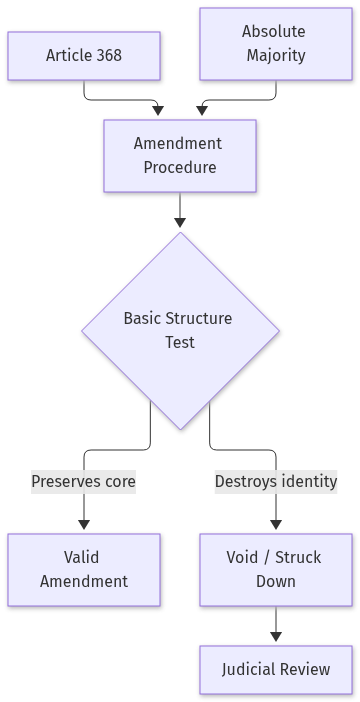
- Not unlimited: Courts hold that “amend” does not include abrogating core features — federalism, secularism, democracy, judicial review, rule of law.
Basic Structure Doctrine
- Kesavananda Bharati (1973): Parliament cannot alter the identity of the Constitution; evolved list includes supremacy of Constitution, republican government, secular character, separation of powers, federal balance, judicial independence.
- Indira Gandhi v. Raj Narain (1975): Free and fair elections part of basic structure.
- Minerva Mills (1980): Struck attempt to immunise amendments from review; harmonised FRs and DPSPs.
Absolute Majority — No Immunity
- Political majority ≠ constituent unlimited power: Even 543/543 Lok Sabha seats cannot delete judicial review or convert India into a one-party authoritarian state via formal amendment.
- Judicial gatekeeping: SC examines substance, not merely procedure; I. R. Coelho (2007) extended review to Ninth Schedule laws violating structure post-1973.
Contemporary Applications
- NJAC Amendment struck down (2015): Independence of judiciary is inviolable.
- Aadhaar, demonetisation, GST federal bargaining: Illustrate amendatory and legislative limits tested in courts.
Flow diagram
Conclusion
Parliament with absolute majority may recalibrate policy and many constitutional details, but cannot demolish the Basic Structure. Constitutional democracy survives majoritarian waves precisely because Article 368 is a conditioned power, not a licence to refound the republic.
Quick related
Students also ask
-
Write short answer of the following questions:
(a) Discuss the major challenges facing India's food processing industry. What initiatives have been taken by government for the improvement?
(b) Jute is in great demand because of cheapness softness, strength length and uniformity of its fibre. Explain its favourable conditions suitable for the Jute cultivation in West Bengal and Bihar.
(c) Describe the role of natural resource management, inclusive development and e-technology for achieving the goal of Atmanirbhar Bharat and Viksit Bharat.
(d) Give an account of the environmental and social benefits of geothermal energy in India with suitable examples.
(e) Describe the initiatives taken by government to enhance inclusive and sustainable development of South Bihar in last 10 years.
Next question on this syllabus topic (2025 · Q4). View answer →
-
Can Parliament abolish judicial review through amendment?
No; judicial review and independence of the judiciary are part of the Basic Structure and cannot be validly removed.
-
Does an absolute Lok Sabha majority bypass the Basic Structure?
No; numerical dominance does not expand amendatory power beyond constitutional identity limits.
More from this topic
Q8 · UPSC Mains 2025 · GS II · 36 marks · Solution
(a) In the perspective of the basics of cyber security, the need for digital sovereignty and the effectiveness of the Prevention of Money Laundering Act (PMLA), suggest components for a comprehensive internal security strategy. Or (b) “The New Indian Space Policy 2023 has opened the floodgates for the private sector.” Is this transition merely about technological development, or has it qualitatively transformed India’s capabilities for national security disaster response and border management? In the context of drone swarm technology, the security of satellite based communication and the strategic significance of GSLV program, propose the essential pillars of a comprehensive ‘Security-Development-Innovation’ strategy for India’s space and allied technologies.
General Studies II
India’s internal security and strategic posture increasingly depend on space-based C4ISR, private innovation under the 2023 Space Policy, and allied technologies (drones, secure satcom, GSLV-class lift) for disaster and border missions.
Q7 · UPSC Mains 2025 · GS II · 36 marks · Solution
Write short answer of the following questions: (See official booklet Section III short notes — cyber security / digital sovereignty / PMLA components and remaining short parts in media/pyq/2025/BPGS2-english.pdf.) In the perspective of the basics of cyber security, the need for digital sovereignty and the effectiveness of the Prevention of Money Laundering Act (PMLA), suggest components for a comprehensive internal security strategy. (Full short-note set: official PDF.)
General Studies II
Internal security in a digital age requires cyber resilience, sovereign control over critical data infrastructure, and anti-money-laundering architecture — PMLA being one pillar among intelligence, policing, and border coordination.
Q6 · UPSC Mains 2025 · GS II · 38 marks · Solution
(a) Discuss the major ports on eastern coast of India. Critically examine the role of Syama Prasad Mookerjee Port, Kolkata (SMPK) in the development of North East India and Bangladesh, giving suitable examples. Or (b) Describe the concept of fourth industrial revolution (Industry 4.0). Critically analyse the biggest benefits and risks of adopting industry 4.0 technologies in India.
General Studies II
Eastern seaboard ports anchor coal, container, and bulk trade for eastern India; SMPK (Kolkata) retains historic hinterland ties to North-East India and Bangladesh via river-sea multimodal networks despite draft limitations.