Revision summary
India’s internal security and strategic posture increasingly depend on space-based C4ISR, private innovation under the 2023 Space Policy, and allied technologies (drones, secure satcom, GSLV-class lift) for disaster and border missions.
Model answer
Introduction
The 2023 Space Policy liberalised private participation while IN-SPACe regulates access. Security planners must integrate commercial agility with sovereign launch capability and hardened satellite communications.
Body
Space Policy 2023 — Beyond Technology
- Private opening: IN-SPACe as single-window; ISRO focuses on R&D and strategic missions; startups in launch, small sats, ground segments.
- Qualitative shift: From supplier-led to ecosystem-led — faster procurement, dual-use innovation, competition lowering costs.
National Security & Disaster Response
- Earth observation: RISAT, Cartosat, EOS fleet for border monitoring, flood mapping (Bihar/Kerala use cases), crop stress.
- Satcom: GSAT series, private LEO constellations for redundant command links; drone swarms need low-latency satcom.
- Navigation: NavIC augmentation for precision guidance and civilian resilience.
Border Management & Drones
- Surveillance swarms: Along LoC/LAC; need spectrum and satellite backhaul.
- GSLV significance: Heavy lift for GEO intelligence and civilian comsats — strategic autonomy vs import dependence.
Security-Development-Innovation Pillars
- Security: Classified payloads, space situational awareness, cyber-hardened ground stations.
- Development: Satellite broadband to aspirational districts; PPP for disaster early warning.
- Innovation: Venture fund for spacetech, testing ranges, academia–DRDO–ISRO clusters.
Flow diagram
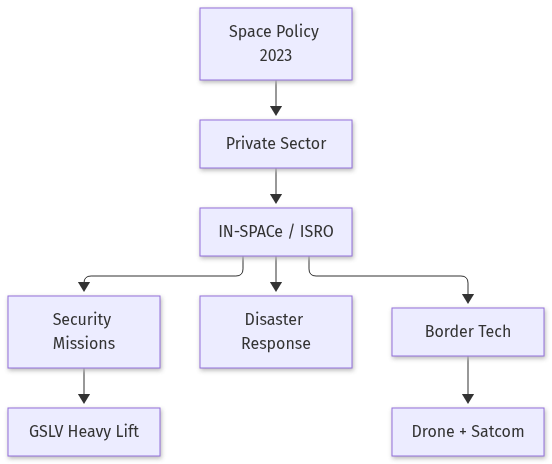
Conclusion
- The 2023 policy marks a strategic inflection: private capital accelerates space, but national security demands sovereign launch, secure satcom, and integrated drone–satellite doctrine under a Security-Development-Innovation tripod serving borders, disasters, and digital India alike.
Quick related
Students also ask
-
Write short answer of the following questions:
(a) Article-32 is the “Heart and Soul of the Constitution of India”. Explain.
(b) "Criminalisation of politics and politicisation of Criminals" Analyse this statement in the context of Bihar State.
(c) “In India, at present caste is no more a social phenomenon, rather it is a political phenomenon”. Do you agree with this statement? Analyse and give reasons to support your answer.
(d) What is collegium? Why is it at the center of criticism? Express your views.
(e) In the light of 73rd and 74th Amendment in the Constitution of India, discuss the role of Local Self Government in empowering the women at the grassroot level in Bihar.
Next question on this syllabus topic (2024 · Q1). View answer →
-
How does the 2023 Space Policy change private participation?
It authorises private launch, satellites, and ground systems via IN-SPACe while ISRO concentrates on advanced R&D and national missions.
-
Why is GSLV strategically important?
Heavy-lift capability reduces reliance on foreign launchers for large communication and surveillance satellites essential to security and disaster networks.
More from this topic
Q7 · UPSC Mains 2025 · GS II · 36 marks · Solution
Write short answer of the following questions: (See official booklet Section III short notes — cyber security / digital sovereignty / PMLA components and remaining short parts in media/pyq/2025/BPGS2-english.pdf.) In the perspective of the basics of cyber security, the need for digital sovereignty and the effectiveness of the Prevention of Money Laundering Act (PMLA), suggest components for a comprehensive internal security strategy. (Full short-note set: official PDF.)
General Studies II
Internal security in a digital age requires cyber resilience, sovereign control over critical data infrastructure, and anti-money-laundering architecture — PMLA being one pillar among intelligence, policing, and border coordination.
Q6 · UPSC Mains 2025 · GS II · 38 marks · Solution
(a) Discuss the major ports on eastern coast of India. Critically examine the role of Syama Prasad Mookerjee Port, Kolkata (SMPK) in the development of North East India and Bangladesh, giving suitable examples. Or (b) Describe the concept of fourth industrial revolution (Industry 4.0). Critically analyse the biggest benefits and risks of adopting industry 4.0 technologies in India.
General Studies II
Eastern seaboard ports anchor coal, container, and bulk trade for eastern India; SMPK (Kolkata) retains historic hinterland ties to North-East India and Bangladesh via river-sea multimodal networks despite draft limitations.
Q5 · UPSC Mains 2025 · GS II · 38 marks · Solution
(a) Discuss the role of railway in the development of country. Critically analyze the geographical, economic and political challenges faced by Indian Railways in enhancing its logistics efficiency in north-eastern part of country? Or (b) What are the components of food security? How far hydroponic agriculture will be helpful to fulfil the future domestic demands in country? Justify it with suitable examples.
General Studies II
Indian Railways is the backbone of bulk freight and long-distance mobility, yet North-Eastern connectivity faces terrain, geopolitical, and capacity constraints that raise logistics costs and slow integration with the mainland economy.