Revision summary
Indian Railways is the backbone of bulk freight and long-distance mobility, yet North-Eastern connectivity faces terrain, geopolitical, and capacity constraints that raise logistics costs and slow integration with the mainland economy.
Model answer
Introduction
Railways shaped colonial integration and post-independence industrial corridors. For the North-East — landlocked, fragile ecology, international borders — rail expansion is both a development tool and a strategic imperative.
Body
Railways and National Development
- Economic: Moves coal, steel, food grains at low marginal cost; enables Make in India supply chains; employment in operations and allied industries.
- Social: Affordable passenger connectivity; pilgrimage and migrant labour corridors (including Bihar–NE routes).
- Strategic: Rapid troop and relief movement; border area access.
North-East Logistics Challenges
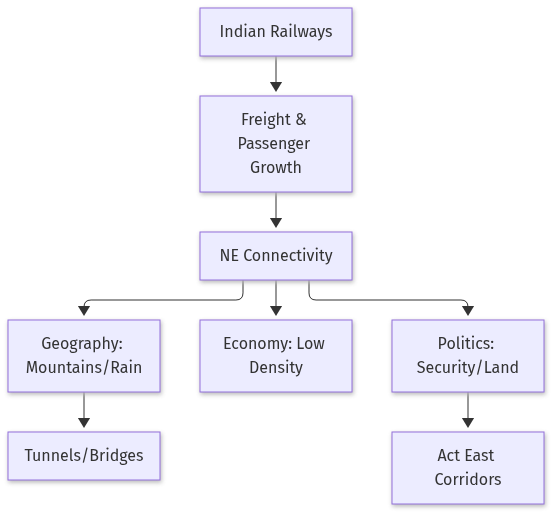
- Geographical: Young folded mountains, high rainfall, landslides, long bridge/tunnel requirements (e.g., Bogibeel, Noney–Imphal).
- Economic: Low traffic density on some lines, high capital cost per route-km, dependency on single broad-gauge corridors through the chicken’s neck (Siliguri).
- Political/Security: Insurgency history, land acquisition sensitivities, cross-border protocols with Bhutan/Bangladesh/Myanmar affecting alternate corridors.
- Efficiency gaps: Diesel legacy, transshipment at break-of-gauge historically, warehousing deficits at Guwahati–Dimapur hubs.
Remedial Thrust
- Projects: Jiribam–Imphal, Agartala–Akhaura, doubling on Lumding–Badarpur, Dedicated Freight Corridor spillovers via transshipment at Kolkata/Haldia.
- Policy: PM Gati Shakti multimodal planning; Bharatmala–Sagarmala interface at NE ports; Act East rail gateways.
Flow diagram
Conclusion
Railways remain indispensable for India’s continental scale, but North-Eastern logistics demands terrain-resilient engineering, multimodal last-mile links, and cooperative federalism on land and security — only then will the region convert geographic isolation into strategic economic depth.
Quick related
Students also ask
-
(a) Discuss the major ports on eastern coast of India. Critically examine the role of Syama Prasad Mookerjee Port, Kolkata (SMPK) in the development of North East India and Bangladesh, giving suitable examples.
Or
(b) Describe the concept of fourth industrial revolution (Industry 4.0). Critically analyse the biggest benefits and risks of adopting industry 4.0 technologies in India.
Next question on this syllabus topic (2025 · Q6). View answer →
-
Why is rail logistics costlier per km in the North-East?
Difficult terrain raises civil engineering costs, traffic density is lower, and dependence on few choke corridors increases delays and transshipment.
-
How do railways contribute to Atmanirbhar Bharat?
By moving bulk raw materials and finished goods cheaply, linking production clusters to ports and consumption centres.
More from this topic
Q8 · UPSC Mains 2025 · GS II · 36 marks · Solution
(a) In the perspective of the basics of cyber security, the need for digital sovereignty and the effectiveness of the Prevention of Money Laundering Act (PMLA), suggest components for a comprehensive internal security strategy. Or (b) “The New Indian Space Policy 2023 has opened the floodgates for the private sector.” Is this transition merely about technological development, or has it qualitatively transformed India’s capabilities for national security disaster response and border management? In the context of drone swarm technology, the security of satellite based communication and the strategic significance of GSLV program, propose the essential pillars of a comprehensive ‘Security-Development-Innovation’ strategy for India’s space and allied technologies.
General Studies II
India’s internal security and strategic posture increasingly depend on space-based C4ISR, private innovation under the 2023 Space Policy, and allied technologies (drones, secure satcom, GSLV-class lift) for disaster and border missions.
Q7 · UPSC Mains 2025 · GS II · 36 marks · Solution
Write short answer of the following questions: (See official booklet Section III short notes — cyber security / digital sovereignty / PMLA components and remaining short parts in media/pyq/2025/BPGS2-english.pdf.) In the perspective of the basics of cyber security, the need for digital sovereignty and the effectiveness of the Prevention of Money Laundering Act (PMLA), suggest components for a comprehensive internal security strategy. (Full short-note set: official PDF.)
General Studies II
Internal security in a digital age requires cyber resilience, sovereign control over critical data infrastructure, and anti-money-laundering architecture — PMLA being one pillar among intelligence, policing, and border coordination.
Q6 · UPSC Mains 2025 · GS II · 38 marks · Solution
(a) Discuss the major ports on eastern coast of India. Critically examine the role of Syama Prasad Mookerjee Port, Kolkata (SMPK) in the development of North East India and Bangladesh, giving suitable examples. Or (b) Describe the concept of fourth industrial revolution (Industry 4.0). Critically analyse the biggest benefits and risks of adopting industry 4.0 technologies in India.
General Studies II
Eastern seaboard ports anchor coal, container, and bulk trade for eastern India; SMPK (Kolkata) retains historic hinterland ties to North-East India and Bangladesh via river-sea multimodal networks despite draft limitations.