Revision summary
Eastern seaboard ports anchor coal, container, and bulk trade for eastern India; SMPK (Kolkata) retains historic hinterland ties to North-East India and Bangladesh via river-sea multimodal networks despite draft limitations.
Model answer
Introduction
India’s eastern ports — Paradip to Chennai — serve mineral, energy, and manufacturing belts. Kolkata’s riverine port uniquely interfaces with Ganga–Padma systems and the Northeast’s overland trade corridors.
Body
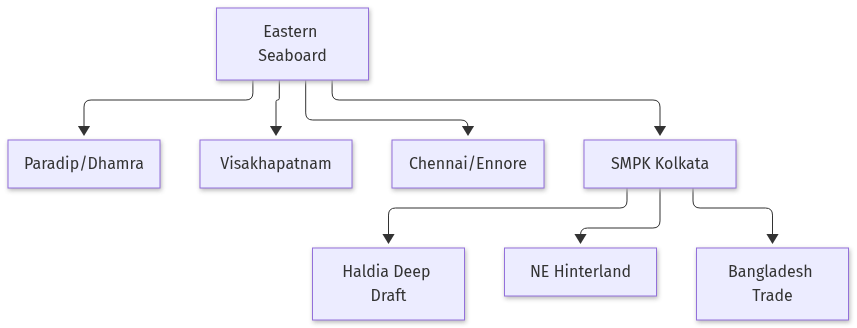
Major Eastern Coast Ports
- Paradip (Odisha): Iron ore, coal, fertiliser; deepest draft among major OR ports.
- Dhamra / Gopalpur: Industrial cargo, petrochemicals.
- Visakhapatnam: Steel, containers, shipbuilding ecosystem.
- Chennai / Ennore: Auto, containers, diversified manufacturing exports.
- Kolkata (SMPK): Riverine port on Hooghly; jute, tea, containers; transloading for lighter draft.
SMPK — Strategic Role
- North-East linkage: Traditional gateway before heavy reliance on Haldia; road-rail from Kolkata to Siliguri feeds NE markets; Inland Waterways Authority routes explored on NW-1.
- Bangladesh trade: Petrapole–Benapole land route complements maritime transhipment; coastal shipping treaties support container relay.
- Constraints: Sedimentation, tidal draft — necessitates satellite deep draft at Haldia/Sagar; modernization under Sagarmala.
Development Examples
- Coastal shipping: Kolkata–Port Blair/Haldia corridors for NE-bound goods.
- ICDS / CFS: Container freight stations in Bengal reduce dwell time for NE consignments.
Flow diagram
Conclusion
Eastern ports diversify India’s maritime economy; SMPK remains culturally and logistically vital for Bengal, the Northeast, and eastern Bangladesh trade, requiring dredging modernization and inland waterway synergy to regain competitive draft.
Quick related
Students also ask
-
Write short answer of the following questions:
(See official booklet Section III short notes — cyber security / digital sovereignty / PMLA components and remaining short parts in media/pyq/2025/BPGS2-english.pdf.)
In the perspective of the basics of cyber security, the need for digital sovereignty and the effectiveness of the Prevention of Money Laundering Act (PMLA), suggest components for a comprehensive internal security strategy. (Full short-note set: official PDF.)
Next question on this syllabus topic (2025 · Q7). View answer →
-
Why is Kolkata a riverine port?
It lies on the Hooghly, 203 km inland, with tidal draft limits requiring dredging and lighterage unlike natural deep harbours.
-
How does SMPK serve the North-East?
Through rail-road feeders to Siliguri and Assam, coastal relay, and inland waterway links from Haldia/NW-1.
More from this topic
Q8 · UPSC Mains 2025 · GS II · 36 marks · Solution
(a) In the perspective of the basics of cyber security, the need for digital sovereignty and the effectiveness of the Prevention of Money Laundering Act (PMLA), suggest components for a comprehensive internal security strategy. Or (b) “The New Indian Space Policy 2023 has opened the floodgates for the private sector.” Is this transition merely about technological development, or has it qualitatively transformed India’s capabilities for national security disaster response and border management? In the context of drone swarm technology, the security of satellite based communication and the strategic significance of GSLV program, propose the essential pillars of a comprehensive ‘Security-Development-Innovation’ strategy for India’s space and allied technologies.
General Studies II
India’s internal security and strategic posture increasingly depend on space-based C4ISR, private innovation under the 2023 Space Policy, and allied technologies (drones, secure satcom, GSLV-class lift) for disaster and border missions.
Q7 · UPSC Mains 2025 · GS II · 36 marks · Solution
Write short answer of the following questions: (See official booklet Section III short notes — cyber security / digital sovereignty / PMLA components and remaining short parts in media/pyq/2025/BPGS2-english.pdf.) In the perspective of the basics of cyber security, the need for digital sovereignty and the effectiveness of the Prevention of Money Laundering Act (PMLA), suggest components for a comprehensive internal security strategy. (Full short-note set: official PDF.)
General Studies II
Internal security in a digital age requires cyber resilience, sovereign control over critical data infrastructure, and anti-money-laundering architecture — PMLA being one pillar among intelligence, policing, and border coordination.
Q5 · UPSC Mains 2025 · GS II · 38 marks · Solution
(a) Discuss the role of railway in the development of country. Critically analyze the geographical, economic and political challenges faced by Indian Railways in enhancing its logistics efficiency in north-eastern part of country? Or (b) What are the components of food security? How far hydroponic agriculture will be helpful to fulfil the future domestic demands in country? Justify it with suitable examples.
General Studies II
Indian Railways is the backbone of bulk freight and long-distance mobility, yet North-Eastern connectivity faces terrain, geopolitical, and capacity constraints that raise logistics costs and slow integration with the mainland economy.