Revision summary
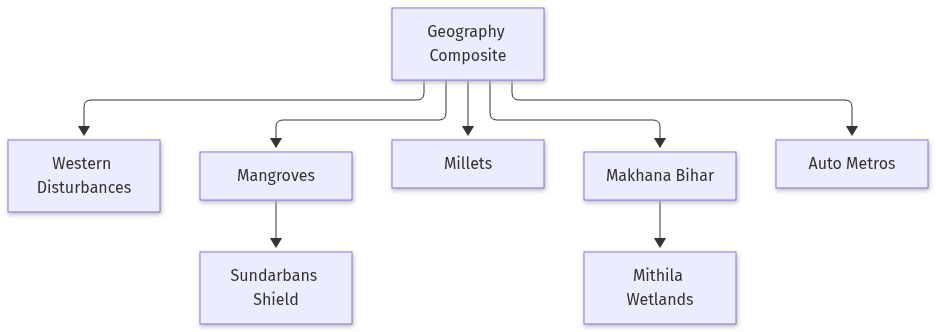
Section-II geography composite on western disturbances, coastal mangroves, millet agro-ecology, Bihar’s makhana wetlands, and auto clusters in Delhi, Mumbai, Chennai, and Kolkata corridors.
Model answer
Introduction
Physical geography intersects economic geography in this paper — monsoon outliers, coastal bioshields, nutri-cereal revival, wetland crops, and industrial locational triangles around million-plus cities.
Body
Winter Rainfall
- Mechanism: Western disturbances — extra-tropical cyclonic systems from Mediterranean/Caspian bring cloud bands to NW and adjoining central India Nov–Feb.
- Benefits: Rabi wheat moisture, snowpack for glaciated north; occasionally benefits East via eastern extensions.
- Spatial spread: Punjab, Haryana, UP, HP, J&K heaviest; Bihar sees occasional winter lines with NE monsoon retreat interactions.
Mangroves — Benefits
- Environmental: Storm surge buffer (cyclones Sidr, Amphan lessons), carbon sequestration, nursery for fisheries.
- Economic: Honey, crab fattening, eco-tourism in Sundarbans, Pichavaram, Bhitarkanika.
- Threats: Sea-level rise, shrimp aquaculture encroachment — CRZ enforcement vital.
Millets — Conditions
- Types: Jowar (semi-arid Deccan), Bajra (Rajasthan/Gujarat), Ragi (Karnataka hills), minor millets (tribal belts).
- Conditions: Low moisture need, warm days, well-drained soils; fit rainfed regions climate-stressed for rice-wheat.
Makhana (Fox Nut)
- Ecology: Grows in marshy ponds of Mithilanchal (Darbhanga, Madhubani, Samastipur); perennial aquatic crop.
- Government: Makhana Board, GI tag for Muzaffarpur/Darbhanga, PMFME support, export promotion.
Automobile Metros
- Delhi-NCR: Maruti Suzuki Gurugram, Hero, Honda two-wheelers.
- Mumbai-Pune: Tata, Mahindra, Chakan belt.
- Chennai: Detroit of India — Hyundai, Ford legacy suppliers.
- Kolkata-Haldia: Heavy commercial vehicles, jute-auto ancillary mix.
Flow diagram
Conclusion
India’s winter rain sustains rabi prosperity; mangroves defend coasts while millets and makhana embody climate-smart agriculture — especially Bihar’s wetland jewel — even as metropolitan auto clusters anchor eastern and western manufacturing belts.
Quick related
Students also ask
-
(a) ‘The Peninsular India is more rich in rock and mineral resources’. Discuss the statement in relation to their geological formations and associated quarrying and mining activities.
Or
(b) Distinguish between the alluvial and the diluvial soils of India and explain their process of formation, characteristics and distribution pattern with examples.
Next question on this syllabus topic (2024 · Q5). View answer →
-
Why are western disturbances important for Indian agriculture?
They provide crucial winter precipitation for rabi crops and snowpack in northern river basins.
-
Where is makhana mainly cultivated in Bihar?
In ponds and wetlands of Mithilanchal districts such as Darbhanga, Madhubani, and Samastipur.
More from this topic
Q8 · UPSC Mains 2025 · GS II · 36 marks · Solution
(a) In the perspective of the basics of cyber security, the need for digital sovereignty and the effectiveness of the Prevention of Money Laundering Act (PMLA), suggest components for a comprehensive internal security strategy. Or (b) “The New Indian Space Policy 2023 has opened the floodgates for the private sector.” Is this transition merely about technological development, or has it qualitatively transformed India’s capabilities for national security disaster response and border management? In the context of drone swarm technology, the security of satellite based communication and the strategic significance of GSLV program, propose the essential pillars of a comprehensive ‘Security-Development-Innovation’ strategy for India’s space and allied technologies.
General Studies II
India’s internal security and strategic posture increasingly depend on space-based C4ISR, private innovation under the 2023 Space Policy, and allied technologies (drones, secure satcom, GSLV-class lift) for disaster and border missions.
Q7 · UPSC Mains 2025 · GS II · 36 marks · Solution
Write short answer of the following questions: (See official booklet Section III short notes — cyber security / digital sovereignty / PMLA components and remaining short parts in media/pyq/2025/BPGS2-english.pdf.) In the perspective of the basics of cyber security, the need for digital sovereignty and the effectiveness of the Prevention of Money Laundering Act (PMLA), suggest components for a comprehensive internal security strategy. (Full short-note set: official PDF.)
General Studies II
Internal security in a digital age requires cyber resilience, sovereign control over critical data infrastructure, and anti-money-laundering architecture — PMLA being one pillar among intelligence, policing, and border coordination.
Q6 · UPSC Mains 2025 · GS II · 38 marks · Solution
(a) Discuss the major ports on eastern coast of India. Critically examine the role of Syama Prasad Mookerjee Port, Kolkata (SMPK) in the development of North East India and Bangladesh, giving suitable examples. Or (b) Describe the concept of fourth industrial revolution (Industry 4.0). Critically analyse the biggest benefits and risks of adopting industry 4.0 technologies in India.
General Studies II
Eastern seaboard ports anchor coal, container, and bulk trade for eastern India; SMPK (Kolkata) retains historic hinterland ties to North-East India and Bangladesh via river-sea multimodal networks despite draft limitations.