Revision summary
Composite Section-I short answers on Article 32, Bihar’s criminal–political nexus, caste as political capital, judicial appointments, and Panchayati Raj’s gender quotas in Bihar.
Model answer
Introduction
Constitutional remedies, electoral ethics, social stratification, judicial appointments, and grassroots decentralisation form the core of Bihar-centric polity questions in contemporary GS-II papers.
Body
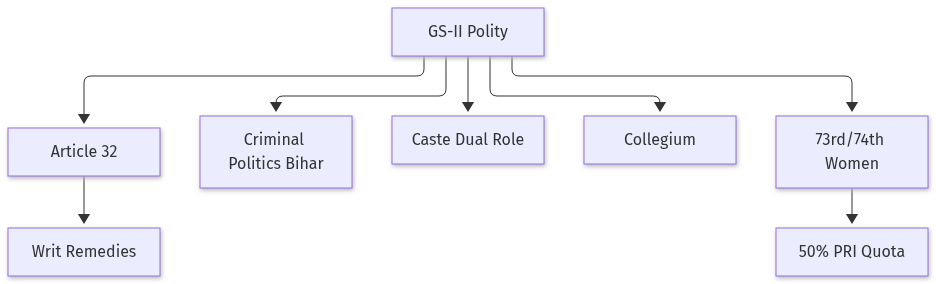
Article 32 — Heart and Soul
- Dr. Ambedkar termed Article 32 the soul because without enforceable remedies, FRs are mere promises.
- Direct access to Supreme Court; five writs; locus standi expanded via PILs.
- Distinguished from Article 226 by national guardianship of constitutionally guaranteed rights.
Criminalisation of Politics — Bihar Context
- Data pattern: ADR reports show significant winner MPs/MLAs with criminal cases; Bihar historically ranks high on serious offence categories.
- Causes: Muscle culture in patronage politics, weak prosecution, slow trials, vote-bank calculus.
- Effects: Eroded governance quality, policy capture, intimidation in elections.
- Reforms: Lily Thomas v. Union of India (disqualification upon conviction); needs faster courts and clean funding.
Caste — Political Phenomenon?
- Thesis partly true: Caste still structures vote banks, party tickets, and welfare targeting; RJD/JD(U)/BSP dynamics illustrate caste arithmetic.
- Counter: Caste remains social — endogamy, occupation networks, atrocity vulnerabilities; politics instrumentalises but does not erase social reality.
- Synthesis: Dual phenomenon — social identity with intensified political mobilisation post-Mandal.
Collegium — Criticism
- System: Supreme Court Collegium recommends appointments/transfers; MoP unresolved after NJAC strike-down.
- Criticisms: Opacity, nepotism perceptions, vacancies, lack of diversity, no parliamentary role.
- View: Independence preserved but accountability and transparency reforms needed without compromising separation of powers.
Local Self-Government and Women in Bihar
- 73rd/74th: One-third reservation; Bihar later increased to 50% in Panchayats and urban local bodies (2006).
- Impact: Women PRI leaders in health, sanitation, Anganwadi monitoring; challenges include proxy sarpanchs, capacity gaps.
- Bihar examples: JEEVIKA-linked SHG leaders entering PRIs; Mukhiyas driving Jal Jeevan monitoring.
Flow diagram
Conclusion
Article 32 vitalises rights; Bihar must confront criminalised politics through expedited justice; caste is simultaneously social and political; collegium reform must balance independence with transparency; Panchayati Raj quotas meaningfully advance women’s grassroots voice when capacity and proxy practices are addressed.
Quick related
Students also ask
-
(a) Trace the Evolution of Political Parties in India from one party dominance to the era of Coalition Governments. Has the coalition politics undermined the authority of the Prime Minister in India? Give reasons.
Or
(b) “When there is a change Government at the Center, the Governor’s also change.” In the context of this statement examine the role of Governor in India as a link between the Center and the States. Can he in any way act according to his own discretion?
Next question on this syllabus topic (2024 · Q2). View answer →
-
Why did Ambedkar call Article 32 the heart and soul?
Because Fundamental Rights without a guaranteed, swift remedy would be unenforceable in practice.
-
Has Bihar’s 50% women quota in PRIs worked?
It increased formal representation but proxy leadership and capacity gaps require training and social support for full empowerment.
More from this topic
Q8 · UPSC Mains 2025 · GS II · 36 marks · Solution
(a) In the perspective of the basics of cyber security, the need for digital sovereignty and the effectiveness of the Prevention of Money Laundering Act (PMLA), suggest components for a comprehensive internal security strategy. Or (b) “The New Indian Space Policy 2023 has opened the floodgates for the private sector.” Is this transition merely about technological development, or has it qualitatively transformed India’s capabilities for national security disaster response and border management? In the context of drone swarm technology, the security of satellite based communication and the strategic significance of GSLV program, propose the essential pillars of a comprehensive ‘Security-Development-Innovation’ strategy for India’s space and allied technologies.
General Studies II
India’s internal security and strategic posture increasingly depend on space-based C4ISR, private innovation under the 2023 Space Policy, and allied technologies (drones, secure satcom, GSLV-class lift) for disaster and border missions.
Q7 · UPSC Mains 2025 · GS II · 36 marks · Solution
Write short answer of the following questions: (See official booklet Section III short notes — cyber security / digital sovereignty / PMLA components and remaining short parts in media/pyq/2025/BPGS2-english.pdf.) In the perspective of the basics of cyber security, the need for digital sovereignty and the effectiveness of the Prevention of Money Laundering Act (PMLA), suggest components for a comprehensive internal security strategy. (Full short-note set: official PDF.)
General Studies II
Internal security in a digital age requires cyber resilience, sovereign control over critical data infrastructure, and anti-money-laundering architecture — PMLA being one pillar among intelligence, policing, and border coordination.
Q6 · UPSC Mains 2025 · GS II · 38 marks · Solution
(a) Discuss the major ports on eastern coast of India. Critically examine the role of Syama Prasad Mookerjee Port, Kolkata (SMPK) in the development of North East India and Bangladesh, giving suitable examples. Or (b) Describe the concept of fourth industrial revolution (Industry 4.0). Critically analyse the biggest benefits and risks of adopting industry 4.0 technologies in India.
General Studies II
Eastern seaboard ports anchor coal, container, and bulk trade for eastern India; SMPK (Kolkata) retains historic hinterland ties to North-East India and Bangladesh via river-sea multimodal networks despite draft limitations.