Revision summary
Peninsular India’s ancient shield hosts diverse metalliferous and non-metallic minerals tied to Dharwar, Cuddapah, and Gondwana formations — driving quarrying, environmental regulation, and tribal rights debates.
Model answer
Introduction
The Indian Plate’s cratons and mobile belts concentrate iron, manganese, bauxite, mica, and gold — unlike the younger Himalayan zone — shaping mining geography and industrial corridors.
Body
Geological Backdrop
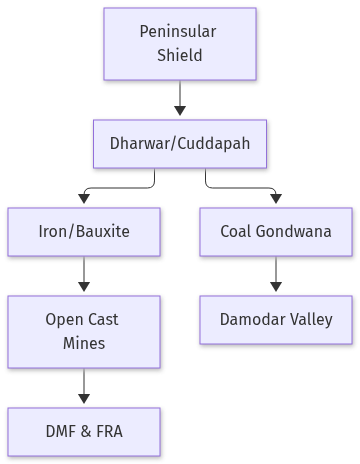
- Shield character: Archaean Dharwar, Bastar cratons; Proterozoic Cuddapah and Vindhyan basins; Gondwana sediments for coal in Damodar valley fringes.
- Tectonic stability: Allows deep regolith and ore concentration versus Himalayan youth with limited metallic ores.
Mineral Wealth
- Ferrous: Bailadila iron (Chhattisgarh), Odisha Keonjhar belt, Karnataka Ballari.
- Non-ferrous: Bauxite Eastern Ghats (Odisha-AP), copper Malanjkhand (MP), gold Kolar/Hatti legacy.
- Strategic: Monazite coasts (thorium), mica Nellore, limestone for cement across Deccan.
Quarrying and Mining Activities
- Open-cast dominance: Iron ore, coal, limestone — economies of scale but landscape scars.
- Environmental: DMF (District Mineral Foundation), Star Rating of mines, EIA clearance, FRA 2006 consent in tribal forests.
- Policy: MMDR Amendment auctions, critical mineral lists (lithium offshore blocks), Atmanirbhar steel linkages.
Flow diagram
Conclusion
Peninsular geology explains India’s bulk mineral leverage; responsible mining must align DMF spending, tribal consent, and decarbonising steel/aluminium pathways with the shield’s finite ore endowment.
Quick related
Students also ask
-
(a) Discuss the causes and consequences of the out migration of population from Bihar and the measures taken by the State to stabilize the population.
Or
(b) Examine the ecological and economic benefits of solar energy generation in India with suitable examples.
Next question on this syllabus topic (2024 · Q6). View answer →
-
Why is Peninsular India richer in metallic minerals than the Himalayas?
Ancient shield rocks underwent long ore-forming processes, whereas young Himalayas are still tectonically active with limited metalliferous concentration.
-
What is the DMF?
A district trust funded by statutory contributions from miners to benefit affected communities.
More from this topic
Q8 · UPSC Mains 2025 · GS II · 36 marks · Solution
(a) In the perspective of the basics of cyber security, the need for digital sovereignty and the effectiveness of the Prevention of Money Laundering Act (PMLA), suggest components for a comprehensive internal security strategy. Or (b) “The New Indian Space Policy 2023 has opened the floodgates for the private sector.” Is this transition merely about technological development, or has it qualitatively transformed India’s capabilities for national security disaster response and border management? In the context of drone swarm technology, the security of satellite based communication and the strategic significance of GSLV program, propose the essential pillars of a comprehensive ‘Security-Development-Innovation’ strategy for India’s space and allied technologies.
General Studies II
India’s internal security and strategic posture increasingly depend on space-based C4ISR, private innovation under the 2023 Space Policy, and allied technologies (drones, secure satcom, GSLV-class lift) for disaster and border missions.
Q7 · UPSC Mains 2025 · GS II · 36 marks · Solution
Write short answer of the following questions: (See official booklet Section III short notes — cyber security / digital sovereignty / PMLA components and remaining short parts in media/pyq/2025/BPGS2-english.pdf.) In the perspective of the basics of cyber security, the need for digital sovereignty and the effectiveness of the Prevention of Money Laundering Act (PMLA), suggest components for a comprehensive internal security strategy. (Full short-note set: official PDF.)
General Studies II
Internal security in a digital age requires cyber resilience, sovereign control over critical data infrastructure, and anti-money-laundering architecture — PMLA being one pillar among intelligence, policing, and border coordination.
Q6 · UPSC Mains 2025 · GS II · 38 marks · Solution
(a) Discuss the major ports on eastern coast of India. Critically examine the role of Syama Prasad Mookerjee Port, Kolkata (SMPK) in the development of North East India and Bangladesh, giving suitable examples. Or (b) Describe the concept of fourth industrial revolution (Industry 4.0). Critically analyse the biggest benefits and risks of adopting industry 4.0 technologies in India.
General Studies II
Eastern seaboard ports anchor coal, container, and bulk trade for eastern India; SMPK (Kolkata) retains historic hinterland ties to North-East India and Bangladesh via river-sea multimodal networks despite draft limitations.