Revision summary
Bihar’s labour out-migration to Delhi-NCR, Punjab, Mumbai, and Gulf states reflects agrarian pressure and industrial deficit; policy responses blend skill, industry, and welfare. Solar energy segment offers national renewable benefits.
Model answer
Introduction
Migration is Bihar’s demographic release valve — remittances sustain villages while thinning working-age cohorts at home, prompting stabilisation through jobs and services.
Body
Out-Migration — Causes
- Economic: Limited factory base, small landholdings, seasonal agriculture, low rural wages.
- Social: Education aspirations, marriage networks in destination cities.
- Historical: Colonial labour flows to plantations; post-1990s construction boom absorption.
Consequences
- Positive: Remittances fund housing, education; skill exposure.
- Negative: Left-behind elderly/children, political constituency depletion, brain drain of youth.
Stabilisation Measures
- Industrial policy: Industrial Area Development Authorities, food processing parks, ethanol plants.
- Skills: Kaushal Yuva, BSMDM; placement-linked training.
- Agriculture: Diversification (makhana, vegetables), irrigation (Har Khet Ko Pani).
- Governance: Bihar@2047 vision, improved law and order for investor confidence.
Solar Energy (Alternate branch awareness)
- Ecological: Cuts CO₂, air pollution; ground-mounted need land-use planning.
- Economic: Declining LCOE, PLI for solar manufacturing, job creation in installation/maintenance.
- Examples: Rajasthan/ Gujarat parks; Bihar rooftop schemes on public buildings.
Flow diagram
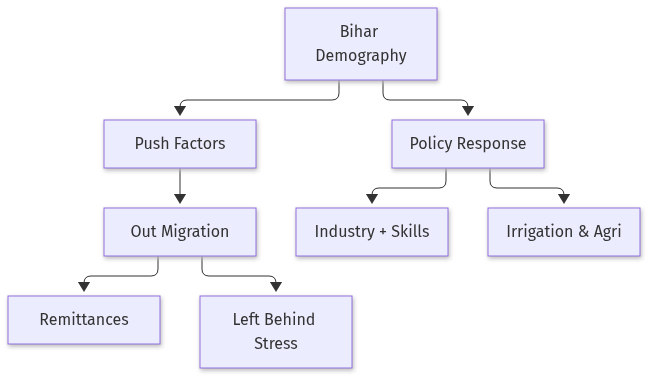
Conclusion
Bihar’s migration is structurally driven; stabilisation needs accelerated industrialisation, agro-value chains, and honest governance — while nationally, solar expansion complements climate goals that indirectly protect agrarian Bihar from climate volatility.
Quick related
Students also ask
-
Write short answer of the following questions:
(a) Explain how science and technology is helping in agricultural productivity and food preservation.
(b) What is cybercrime? Write different types of cybercrime and explain how technology is helping to minimize such crimes?
(c) “We need science and technology in every sphere of life beginning from the treatment of diseases, such as cancer to book a train/air ticket”. Justify the statement.
(d) Describe how technology of DNA fingerprinting helps in the area of forensic science.
(e) Discuss skill/education technology initiatives in different regions of Bihar to prepare students for the future workforce. (see official PDF for exact wording)
(f) Explain how the drone technology in India is helping extensively in various areas of national security. Justify with suitable examples.
Next question on this syllabus topic (2024 · Q7). View answer →
-
What is the main economic driver of Bihar’s out-migration?
Insufficient local non-farm jobs relative to a large youthful workforce depending on low-productivity agriculture.
-
How can solar benefit Bihar specifically?
Through irrigation pumps, rooftop power for schools and health centres, and substituting diesel in remote areas.
More from this topic
Q8 · UPSC Mains 2025 · GS II · 36 marks · Solution
(a) In the perspective of the basics of cyber security, the need for digital sovereignty and the effectiveness of the Prevention of Money Laundering Act (PMLA), suggest components for a comprehensive internal security strategy. Or (b) “The New Indian Space Policy 2023 has opened the floodgates for the private sector.” Is this transition merely about technological development, or has it qualitatively transformed India’s capabilities for national security disaster response and border management? In the context of drone swarm technology, the security of satellite based communication and the strategic significance of GSLV program, propose the essential pillars of a comprehensive ‘Security-Development-Innovation’ strategy for India’s space and allied technologies.
General Studies II
India’s internal security and strategic posture increasingly depend on space-based C4ISR, private innovation under the 2023 Space Policy, and allied technologies (drones, secure satcom, GSLV-class lift) for disaster and border missions.
Q7 · UPSC Mains 2025 · GS II · 36 marks · Solution
Write short answer of the following questions: (See official booklet Section III short notes — cyber security / digital sovereignty / PMLA components and remaining short parts in media/pyq/2025/BPGS2-english.pdf.) In the perspective of the basics of cyber security, the need for digital sovereignty and the effectiveness of the Prevention of Money Laundering Act (PMLA), suggest components for a comprehensive internal security strategy. (Full short-note set: official PDF.)
General Studies II
Internal security in a digital age requires cyber resilience, sovereign control over critical data infrastructure, and anti-money-laundering architecture — PMLA being one pillar among intelligence, policing, and border coordination.
Q6 · UPSC Mains 2025 · GS II · 38 marks · Solution
(a) Discuss the major ports on eastern coast of India. Critically examine the role of Syama Prasad Mookerjee Port, Kolkata (SMPK) in the development of North East India and Bangladesh, giving suitable examples. Or (b) Describe the concept of fourth industrial revolution (Industry 4.0). Critically analyse the biggest benefits and risks of adopting industry 4.0 technologies in India.
General Studies II
Eastern seaboard ports anchor coal, container, and bulk trade for eastern India; SMPK (Kolkata) retains historic hinterland ties to North-East India and Bangladesh via river-sea multimodal networks despite draft limitations.