Revision summary
Linguistic identity has shaped statehood demands, education policy, and party systems since the States Reorganisation Act; parallel track — post-2019 J&K reorganisation redefined federal status and citizenship rules.
Model answer
Introduction
Language movements produced Andhra, Maharashtra, and Punjab reorganisations; J&K’s 2019 changes ended separate constitution status, splitting the erstwhile State into two UTs.
Body
Linguistic Identity — Political Impact
- State formation: 1956 reorganisation on linguistic lines reduced secessionist pressures while creating regional power centres.
- Party systems: DMK/AIADMK, Shiv Sena legacy, AGP — language anchors regional competitiveness versus national parties.
- Policy contestation: Official language imposition debates (Hindi vs Eighth Schedule equality); medium-of-instruction fights in courts and streets.
- Identity politics: Language bonds with culture — Kokborok, Maithili, Bhojpuri demands show continuing mobilisation.
- Federal balance: Eighth Schedule expansion and three-language formula as compromise.
J&K After Article 370 — Constitutional Changes
- August 2019 actions: Article 370 effectively diluted; Article 35A ceased; J&K Reorganisation Act created UT of J&K and UT of Ladakh.
- Political impact: Statehood suspended; Lieutenant Governor administration; delimitation and electoral rolls expansion.
- Constitutional: Application of entire Constitution with adaptations; domicile rules revised; property and job eligibility broadened.
- Security–development narrative: Central laws (Panchayati Raj, RTI, CAA inapplicability debated) extended; investment summits projected.
- Contestations: Petitions on abrogation procedure; restoration of statehood remains political demand.
Flow diagram
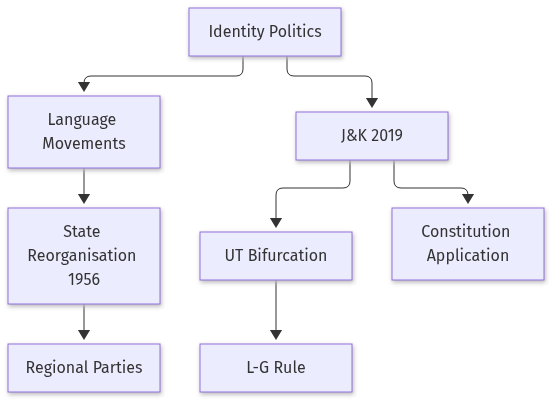
Conclusion
Linguistic identity remains a durable axis of Indian federal politics when managed through inclusive schedules and education autonomy; J&K’s post-2019 map re-centred Union oversight while re-opening debates on federal asymmetry and democratic representation.
Quick related
Students also ask
-
Write short answer of the following questions:
(a) Explain the climatic conditions and mechanism of winter rainfall in India with their spatial spread.
(b) Discuss the environmental and economic benefits of mangrove forest cover along the Indian coast with examples.
(c) What are the suitable geographical conditions for the cultivation of major types of millets in India? Explain with examples.
(d) Explain the ecological conditions suitable for the cultivation of Makhana (Foxseeds or Lotus seeds) crop. What measures are being taken by the Government to increase its production and marketing?
(e) Discuss the growth and development of automobile industries in and around four largest metropolitan city regions of India.
Next question on this syllabus topic (2024 · Q4). View answer →
-
Did linguistic reorganisation strengthen or weaken unity?
It mostly absorbed centrifugal pressures into federal states, though border disputes and minority languages require ongoing accommodation.
-
What is J&K’s current constitutional status?
Union Territory of Jammu and Kashmir with a legislature; Ladakh is a separate UT without legislature.
More from this topic
Q8 · UPSC Mains 2025 · GS II · 36 marks · Solution
(a) In the perspective of the basics of cyber security, the need for digital sovereignty and the effectiveness of the Prevention of Money Laundering Act (PMLA), suggest components for a comprehensive internal security strategy. Or (b) “The New Indian Space Policy 2023 has opened the floodgates for the private sector.” Is this transition merely about technological development, or has it qualitatively transformed India’s capabilities for national security disaster response and border management? In the context of drone swarm technology, the security of satellite based communication and the strategic significance of GSLV program, propose the essential pillars of a comprehensive ‘Security-Development-Innovation’ strategy for India’s space and allied technologies.
General Studies II
India’s internal security and strategic posture increasingly depend on space-based C4ISR, private innovation under the 2023 Space Policy, and allied technologies (drones, secure satcom, GSLV-class lift) for disaster and border missions.
Q7 · UPSC Mains 2025 · GS II · 36 marks · Solution
Write short answer of the following questions: (See official booklet Section III short notes — cyber security / digital sovereignty / PMLA components and remaining short parts in media/pyq/2025/BPGS2-english.pdf.) In the perspective of the basics of cyber security, the need for digital sovereignty and the effectiveness of the Prevention of Money Laundering Act (PMLA), suggest components for a comprehensive internal security strategy. (Full short-note set: official PDF.)
General Studies II
Internal security in a digital age requires cyber resilience, sovereign control over critical data infrastructure, and anti-money-laundering architecture — PMLA being one pillar among intelligence, policing, and border coordination.
Q6 · UPSC Mains 2025 · GS II · 38 marks · Solution
(a) Discuss the major ports on eastern coast of India. Critically examine the role of Syama Prasad Mookerjee Port, Kolkata (SMPK) in the development of North East India and Bangladesh, giving suitable examples. Or (b) Describe the concept of fourth industrial revolution (Industry 4.0). Critically analyse the biggest benefits and risks of adopting industry 4.0 technologies in India.
General Studies II
Eastern seaboard ports anchor coal, container, and bulk trade for eastern India; SMPK (Kolkata) retains historic hinterland ties to North-East India and Bangladesh via river-sea multimodal networks despite draft limitations.