Revision summary
Bihar’s resource base centres on fertile soil, groundwater, limestone, coal (minor), sand, and mica/schist patches — unlike mineral-heavy states but vital for agro-industry and construction.
Model answer
Introduction
The question expects enumeration then deep dive into two — commonly coal in Rajmahal field and limestone in Kaimur, or sand aggregates along Gandak.
Body
Resource Overview
- Agricultural land: Gangetic alluvium — primary wealth.
- Minerals: Limestone (Kaimur), mica, sand/stone quarries.
- Energy: Rajmahal coalfield (ECL), limited petroleum potential.
- Water: Groundwater and river fisheries.
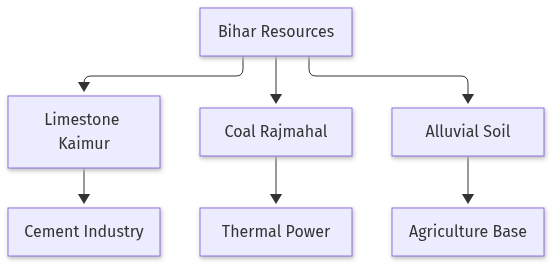
Limestone — Kaimur Belt
- Pockets: Kaimur plateau, Rohtas districts.
- Importance: Cement plants (Banjari, etc.), construction material; employment in quarries with environmental regulation needs.
Coal — Rajmahal Field
- Pockets: Godda (Jharkhand spillover) and Sahebganj border; Bihar consumers.
- Importance: Thermal power feed (e.g., vendors to Barh NTPC); local development debates on land and tribals.
Economic Narration
- Linkages: Cement from limestone feeds infrastructure boom; coal supports regional energy security though Bihar is net power importer.
Flow diagram
Conclusion
Bihar’s economic geology is modest but strategic — Kaimur limestone underpins cement-led construction while coal linkages power industrialisation attempts, both needing sustainable mining and revenue sharing with local communities.
Quick related
Students also ask
-
Quality of life and health of any nation is directly linked to food and dietetic security. India has made appreciable achievements in terms of production, productivity, availability of food grains, horticultural produce, etc. In view of the above perspective, discuss the role of technology in agricultural development of Bihar.
Next question on this syllabus topic (2022 · Q9). View answer →
-
Which mineral supports Bihar’s cement industry?
Limestone from the Kaimur plateau region.
-
Does Bihar produce significant coal?
Production is limited compared to Jharkhand, but Rajmahal field serves regional power plants including Bihar consumers.
More from this topic
Q8 · UPSC Mains 2025 · GS II · 36 marks · Solution
(a) In the perspective of the basics of cyber security, the need for digital sovereignty and the effectiveness of the Prevention of Money Laundering Act (PMLA), suggest components for a comprehensive internal security strategy. Or (b) “The New Indian Space Policy 2023 has opened the floodgates for the private sector.” Is this transition merely about technological development, or has it qualitatively transformed India’s capabilities for national security disaster response and border management? In the context of drone swarm technology, the security of satellite based communication and the strategic significance of GSLV program, propose the essential pillars of a comprehensive ‘Security-Development-Innovation’ strategy for India’s space and allied technologies.
General Studies II
India’s internal security and strategic posture increasingly depend on space-based C4ISR, private innovation under the 2023 Space Policy, and allied technologies (drones, secure satcom, GSLV-class lift) for disaster and border missions.
Q7 · UPSC Mains 2025 · GS II · 36 marks · Solution
Write short answer of the following questions: (See official booklet Section III short notes — cyber security / digital sovereignty / PMLA components and remaining short parts in media/pyq/2025/BPGS2-english.pdf.) In the perspective of the basics of cyber security, the need for digital sovereignty and the effectiveness of the Prevention of Money Laundering Act (PMLA), suggest components for a comprehensive internal security strategy. (Full short-note set: official PDF.)
General Studies II
Internal security in a digital age requires cyber resilience, sovereign control over critical data infrastructure, and anti-money-laundering architecture — PMLA being one pillar among intelligence, policing, and border coordination.
Q6 · UPSC Mains 2025 · GS II · 38 marks · Solution
(a) Discuss the major ports on eastern coast of India. Critically examine the role of Syama Prasad Mookerjee Port, Kolkata (SMPK) in the development of North East India and Bangladesh, giving suitable examples. Or (b) Describe the concept of fourth industrial revolution (Industry 4.0). Critically analyse the biggest benefits and risks of adopting industry 4.0 technologies in India.
General Studies II
Eastern seaboard ports anchor coal, container, and bulk trade for eastern India; SMPK (Kolkata) retains historic hinterland ties to North-East India and Bangladesh via river-sea multimodal networks despite draft limitations.