Revision summary
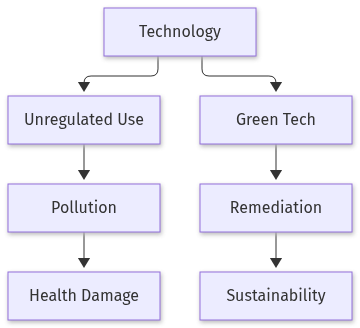
Technology becomes a curse when deployed without safeguards — fossil combustion, toxic releases, plastic waste — though it can also remediate if governed.
Model answer
Introduction
The provocative statement targets blind technicism ignoring externalities along the Gangetic industrial corridor and informal e-waste sectors.
Body
Curse Dimensions
- Air: Coal plants, brick kilns, vehicular exhaust — PM2.5 mortality burden.
- Water: Tannery and dye effluents; arsenic/fluoride geogenic pollution worsened by tubewell tech over-extraction.
- Soil: Pesticide residue, solid waste leachate.
- Climate: GHG from fossil-dependent industrialisation.
Illustrative Indian Examples
- Delhi-NCR stubble burning + industrial cocktail.
- Ganga organic load despite treatment plants underutilised.
- E-waste hubs burning copper wiring.
Counterpoint — Conditional Blessing
- Clean tech: Scrubbers, ZLD, electric mobility, remote sensing for enforcement can flip outcomes when regulated.
Flow diagram
Conclusion
Technology is morally neutral — a curse when extractive and unregulated, a blessing when steered by environmental rule of law and circular economy design; India’s pollution crises prove the former when institutions lag.
Quick related
Students also ask
-
Bihar is a flood-prone State. How can the modern technology help to control floods and manage this kind of disaster? Give your explanations with suitable example.
Next question on this syllabus topic (2022 · Q11). View answer →
-
When does technology become an environmental curse?
When innovation deploys without pollution controls, waste management, or social cost accounting.
-
Bihar-specific tech pollution example?
Brick kiln clusters emitting PM affecting Gangetic airsheds during winter inversion conditions.
More from this topic
Q8 · UPSC Mains 2025 · GS II · 36 marks · Solution
(a) In the perspective of the basics of cyber security, the need for digital sovereignty and the effectiveness of the Prevention of Money Laundering Act (PMLA), suggest components for a comprehensive internal security strategy. Or (b) “The New Indian Space Policy 2023 has opened the floodgates for the private sector.” Is this transition merely about technological development, or has it qualitatively transformed India’s capabilities for national security disaster response and border management? In the context of drone swarm technology, the security of satellite based communication and the strategic significance of GSLV program, propose the essential pillars of a comprehensive ‘Security-Development-Innovation’ strategy for India’s space and allied technologies.
General Studies II
India’s internal security and strategic posture increasingly depend on space-based C4ISR, private innovation under the 2023 Space Policy, and allied technologies (drones, secure satcom, GSLV-class lift) for disaster and border missions.
Q7 · UPSC Mains 2025 · GS II · 36 marks · Solution
Write short answer of the following questions: (See official booklet Section III short notes — cyber security / digital sovereignty / PMLA components and remaining short parts in media/pyq/2025/BPGS2-english.pdf.) In the perspective of the basics of cyber security, the need for digital sovereignty and the effectiveness of the Prevention of Money Laundering Act (PMLA), suggest components for a comprehensive internal security strategy. (Full short-note set: official PDF.)
General Studies II
Internal security in a digital age requires cyber resilience, sovereign control over critical data infrastructure, and anti-money-laundering architecture — PMLA being one pillar among intelligence, policing, and border coordination.
Q6 · UPSC Mains 2025 · GS II · 38 marks · Solution
(a) Discuss the major ports on eastern coast of India. Critically examine the role of Syama Prasad Mookerjee Port, Kolkata (SMPK) in the development of North East India and Bangladesh, giving suitable examples. Or (b) Describe the concept of fourth industrial revolution (Industry 4.0). Critically analyse the biggest benefits and risks of adopting industry 4.0 technologies in India.
General Studies II
Eastern seaboard ports anchor coal, container, and bulk trade for eastern India; SMPK (Kolkata) retains historic hinterland ties to North-East India and Bangladesh via river-sea multimodal networks despite draft limitations.