Revision summary
Technology — from seed to smartphone — can raise Bihar’s agricultural productivity, resilience, and market access amid flood and fragmentation constraints.
Model answer
Introduction
Food security achievements nationally set the backdrop; Bihar needs precision input use, post-harvest tech, and climate-smart tools.
Body
Productivity Tools
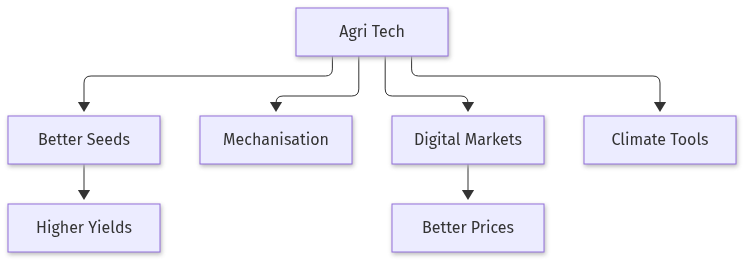
- Seeds: Stress-tolerant rice, hybrid maize for flood-prone tracts.
- Precision: Soil health cards, micro-irrigation pilots, drone spraying demos.
Mechanisation and Post-Harvest
- Equipment: Custom hiring centres for transplanters, combine harvesters in rice-wheat rotations.
- Storage: Solar cold rooms, hermetic bags limiting fungal loss in maize.
Digital Agriculture
- Platforms: e-NAM, AGMARKNET price discovery; Kisan Call Centre; Bihar Krishi app advisories.
- Fintech: KCC saturation, e-Shram registration for migrant-agri workers.
Climate Resilience
- Flood-tolerant varieties; early warning SMS; satellite crop insurance under PMFBY.
Institutions
- RAU Pusa, Sabour: Research extension; KVK network training farmers.
Flow diagram
Conclusion
Bihar agriculture upgrades when lab-to-land pipelines, affordable mechanisation, and digital markets reach smallholders — not merely when production records break in isolated blocks.
Quick related
Students also ask
-
“Technology being more of a curse than a blessing.” Justify the statement in context to the environmental pollution.
Next question on this syllabus topic (2022 · Q10). View answer →
-
Which technology helps Bihar flood-risk rice?
Submergence-tolerant rice varieties coupled with early flood alerts and raised-bed plots in pilot blocks.
-
How does e-NAM help Bihar farmers?
By enabling transparent bidding across mandis and reducing middleman capture on prices.
More from this topic
Q8 · UPSC Mains 2025 · GS II · 36 marks · Solution
(a) In the perspective of the basics of cyber security, the need for digital sovereignty and the effectiveness of the Prevention of Money Laundering Act (PMLA), suggest components for a comprehensive internal security strategy. Or (b) “The New Indian Space Policy 2023 has opened the floodgates for the private sector.” Is this transition merely about technological development, or has it qualitatively transformed India’s capabilities for national security disaster response and border management? In the context of drone swarm technology, the security of satellite based communication and the strategic significance of GSLV program, propose the essential pillars of a comprehensive ‘Security-Development-Innovation’ strategy for India’s space and allied technologies.
General Studies II
India’s internal security and strategic posture increasingly depend on space-based C4ISR, private innovation under the 2023 Space Policy, and allied technologies (drones, secure satcom, GSLV-class lift) for disaster and border missions.
Q7 · UPSC Mains 2025 · GS II · 36 marks · Solution
Write short answer of the following questions: (See official booklet Section III short notes — cyber security / digital sovereignty / PMLA components and remaining short parts in media/pyq/2025/BPGS2-english.pdf.) In the perspective of the basics of cyber security, the need for digital sovereignty and the effectiveness of the Prevention of Money Laundering Act (PMLA), suggest components for a comprehensive internal security strategy. (Full short-note set: official PDF.)
General Studies II
Internal security in a digital age requires cyber resilience, sovereign control over critical data infrastructure, and anti-money-laundering architecture — PMLA being one pillar among intelligence, policing, and border coordination.
Q6 · UPSC Mains 2025 · GS II · 38 marks · Solution
(a) Discuss the major ports on eastern coast of India. Critically examine the role of Syama Prasad Mookerjee Port, Kolkata (SMPK) in the development of North East India and Bangladesh, giving suitable examples. Or (b) Describe the concept of fourth industrial revolution (Industry 4.0). Critically analyse the biggest benefits and risks of adopting industry 4.0 technologies in India.
General Studies II
Eastern seaboard ports anchor coal, container, and bulk trade for eastern India; SMPK (Kolkata) retains historic hinterland ties to North-East India and Bangladesh via river-sea multimodal networks despite draft limitations.