Revision summary
Bihar remains industrially laggard versus national averages — historical neglect, geography, and policy gaps — while recent food processing, ethanol, and pharma pushes aim to narrow the gap.
Model answer
Introduction
Comparing Bihar’s low industrial GSDP share with India’s diversified manufacturing map frames the state’s catch-up challenge.
Body
Picture — Bihar vs India
- National: Diversified hubs — autos, pharma, electronics, steel corridors.
- Bihar: Agro-based units, bricks, small food processing; limited large-scale manufacturing.
- Indices: Low per capita income; small organised sector employment share.
Causes of Backwardness
- History: Bengal Presidency shift; freight equalisation hurt mineral advantage post-partition.
- Land lockedness: Higher logistics cost; investor perception on law and order (improving).
- Social: Skill gaps; capital scarcity; brain drain.
Remedial Steps
- Policies: Bihar Industrial Investment Promotion Policy, single window BSWAN, plug-and-play parks.
- Projects: Ethanol plants, mega food park Aurangabad, leather cluster Muzaffarpur.
- Centres: IIT Patna, NIT Patna, hubs for R&D spillovers hoped.
Flow diagram
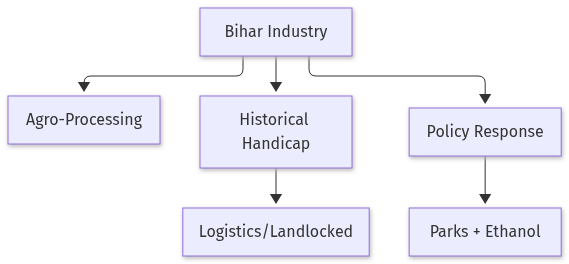
Conclusion
Bihar’s industrialisation needs sustained investor trust, east-side logistics links, and MSME finance — recent policies are directionally right but require execution scale to match national manufacturing momentum.
Quick related
Students also ask
-
It is said that ‘JEEVIKA (BRLPS) is a tool of women empowerment’. Give an introduction of this project and describe its objectives. Evaluate the role of ‘JEEVIKA SCHEME’ in the context of women empowerment in Bihar.
Next question on this syllabus topic (2022 · Q6). View answer →
-
Why did freight equalisation hurt Bihar?
It subsidised transport of minerals, reducing incentive to locate heavy industry near Bihar’s resource belt.
-
Which sector leads recent industrial push?
Food processing and ethanol/distillery units leveraging agricultural output.
More from this topic
Q8 · UPSC Mains 2025 · GS II · 36 marks · Solution
(a) In the perspective of the basics of cyber security, the need for digital sovereignty and the effectiveness of the Prevention of Money Laundering Act (PMLA), suggest components for a comprehensive internal security strategy. Or (b) “The New Indian Space Policy 2023 has opened the floodgates for the private sector.” Is this transition merely about technological development, or has it qualitatively transformed India’s capabilities for national security disaster response and border management? In the context of drone swarm technology, the security of satellite based communication and the strategic significance of GSLV program, propose the essential pillars of a comprehensive ‘Security-Development-Innovation’ strategy for India’s space and allied technologies.
General Studies II
India’s internal security and strategic posture increasingly depend on space-based C4ISR, private innovation under the 2023 Space Policy, and allied technologies (drones, secure satcom, GSLV-class lift) for disaster and border missions.
Q7 · UPSC Mains 2025 · GS II · 36 marks · Solution
Write short answer of the following questions: (See official booklet Section III short notes — cyber security / digital sovereignty / PMLA components and remaining short parts in media/pyq/2025/BPGS2-english.pdf.) In the perspective of the basics of cyber security, the need for digital sovereignty and the effectiveness of the Prevention of Money Laundering Act (PMLA), suggest components for a comprehensive internal security strategy. (Full short-note set: official PDF.)
General Studies II
Internal security in a digital age requires cyber resilience, sovereign control over critical data infrastructure, and anti-money-laundering architecture — PMLA being one pillar among intelligence, policing, and border coordination.
Q6 · UPSC Mains 2025 · GS II · 38 marks · Solution
(a) Discuss the major ports on eastern coast of India. Critically examine the role of Syama Prasad Mookerjee Port, Kolkata (SMPK) in the development of North East India and Bangladesh, giving suitable examples. Or (b) Describe the concept of fourth industrial revolution (Industry 4.0). Critically analyse the biggest benefits and risks of adopting industry 4.0 technologies in India.
General Studies II
Eastern seaboard ports anchor coal, container, and bulk trade for eastern India; SMPK (Kolkata) retains historic hinterland ties to North-East India and Bangladesh via river-sea multimodal networks despite draft limitations.