Revision summary
Bihar exemplifies Centre–State friction and cooperation — finance, floods, education, and law and order — with cooperative federalism as the constructive path.
Model answer
Introduction
From Finance Commission devolution to flood management on the Ganga, Bihar’s federal experience blends dependency and assertion.
Body
Problem Areas
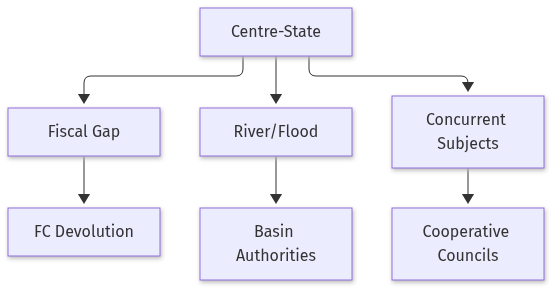
- Fiscal: Vertical imbalance; dependence on FC grants and CSS matching funds; Bihar’s low tax base.
- River/flood: Multi-state Ganga barrage and embankment disputes; NDMA versus state disaster response.
- Education/health: Concurrent subjects — NEET, Ayushman convergence complexities.
- Law and order: Concurrent criminal law; NIA/ED cases intersecting state policing.
Bihar Specifics
- Special category status demand: Unmet; affects plan assistance historically.
- Migration policy: Interstate coordination on migrant welfare (COVID returnees).
- Industries: Single-window competition with neighbouring UP/WB.
Cooperative Federalism Prospects
- Institutions: NITI Aayog, GST Council as templates; ISFC recommendations.
- Sector wins: Jal Jeevan Mission cost-sharing; food security PDS digitisation.
- Constructive handling: Early consultation on concurrent bills; disaster compacts; river basin authorities with Bihar voice.
Flow diagram
Conclusion
Bihar’s federal story is negotiation-heavy; future stability demands formula-based finance, joint river management, and respectful use of Article 263 forums instead of unilateral central directives.
Quick related
Students also ask
-
Account for the emergence of regional political parties in India. Do you think the existence of the regional political parties is good for satisfying regional aspirations and national unity? Give reason in support of your answer.
Next question on this syllabus topic (2022 · Q3). View answer →
-
Why does Bihar press for special category status?
To gain higher central assistance reflecting its low resource base and development backlog.
-
What is cooperative federalism in flood context?
Joint embankment maintenance, shared early warning systems, and agreed reservoir release protocols among basin states.
More from this topic
Q8 · UPSC Mains 2025 · GS II · 36 marks · Solution
(a) In the perspective of the basics of cyber security, the need for digital sovereignty and the effectiveness of the Prevention of Money Laundering Act (PMLA), suggest components for a comprehensive internal security strategy. Or (b) “The New Indian Space Policy 2023 has opened the floodgates for the private sector.” Is this transition merely about technological development, or has it qualitatively transformed India’s capabilities for national security disaster response and border management? In the context of drone swarm technology, the security of satellite based communication and the strategic significance of GSLV program, propose the essential pillars of a comprehensive ‘Security-Development-Innovation’ strategy for India’s space and allied technologies.
General Studies II
India’s internal security and strategic posture increasingly depend on space-based C4ISR, private innovation under the 2023 Space Policy, and allied technologies (drones, secure satcom, GSLV-class lift) for disaster and border missions.
Q7 · UPSC Mains 2025 · GS II · 36 marks · Solution
Write short answer of the following questions: (See official booklet Section III short notes — cyber security / digital sovereignty / PMLA components and remaining short parts in media/pyq/2025/BPGS2-english.pdf.) In the perspective of the basics of cyber security, the need for digital sovereignty and the effectiveness of the Prevention of Money Laundering Act (PMLA), suggest components for a comprehensive internal security strategy. (Full short-note set: official PDF.)
General Studies II
Internal security in a digital age requires cyber resilience, sovereign control over critical data infrastructure, and anti-money-laundering architecture — PMLA being one pillar among intelligence, policing, and border coordination.
Q6 · UPSC Mains 2025 · GS II · 38 marks · Solution
(a) Discuss the major ports on eastern coast of India. Critically examine the role of Syama Prasad Mookerjee Port, Kolkata (SMPK) in the development of North East India and Bangladesh, giving suitable examples. Or (b) Describe the concept of fourth industrial revolution (Industry 4.0). Critically analyse the biggest benefits and risks of adopting industry 4.0 technologies in India.
General Studies II
Eastern seaboard ports anchor coal, container, and bulk trade for eastern India; SMPK (Kolkata) retains historic hinterland ties to North-East India and Bangladesh via river-sea multimodal networks despite draft limitations.