Revision summary
Bihar’s near-bottom Health Index rank reflects neonatal mortality, doctor shortages, and infrastructure deficits — partially addressed through Ayushman Bharat, medical colleges, and CHC upgrades but gaps remain.
Model answer
Introduction
Health outcomes lag despite rising budgets; structural human resource and quality issues persist.
Body
Factors Behind Poor Rank
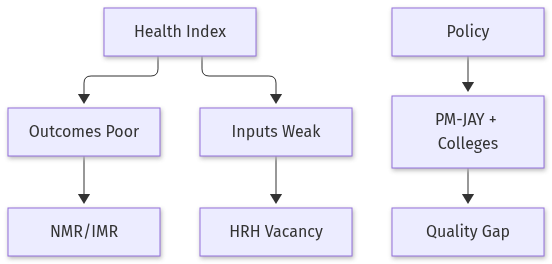
- Outcomes: High neonatal/infant mortality vs national decline trends.
- Inputs: Doctor-nurse vacancies; specialist gaps in CHCs.
- Systems: Weak cold chain historically; limited tertiary care outside Patna.
- Social determinants: Malnutrition, anaemia, open defaecation legacy though improving.
Government Steps
- Insurance: PM-JAY expansion; state schemes integration.
- Infrastructure: New medical colleges (Chapra, Purnia, Madhepura etc.), AIIMS Patna expansion.
- Programs: TB Mukt Bharat, anemia mukt strategy, Ayushman Bharat Health Infrastructure Mission.
Sufficiency?
- Partial: Access improving; quality and HRH recruitment still insufficient for rank jump.
- Need: Nurse tutors, rural bonds for doctors, primary care strengthening, data-driven accountability.
Flow diagram
Conclusion
Bihar’s health index will rise only when medical college expansion pairs with staffed PHCs/CHCs and nutrition convergence — insurance cards alone cannot substitute provider density.
Quick related
Students also ask
-
Write the name of major natural resources existing in Bihar State. Out of these, select any two and show the pockets where they are found and narrate their importance in Bihar’s economic development.
Next question on this syllabus topic (2022 · Q8). View answer →
-
Why is Bihar 18th of 19 large States?
Because outcome indicators like neonatal mortality and service quality lag despite some infrastructure gains.
-
Are new medical colleges enough?
They help tertiary access but primary and CHC staffing remains the binding constraint.
More from this topic
Q8 · UPSC Mains 2025 · GS II · 36 marks · Solution
(a) In the perspective of the basics of cyber security, the need for digital sovereignty and the effectiveness of the Prevention of Money Laundering Act (PMLA), suggest components for a comprehensive internal security strategy. Or (b) “The New Indian Space Policy 2023 has opened the floodgates for the private sector.” Is this transition merely about technological development, or has it qualitatively transformed India’s capabilities for national security disaster response and border management? In the context of drone swarm technology, the security of satellite based communication and the strategic significance of GSLV program, propose the essential pillars of a comprehensive ‘Security-Development-Innovation’ strategy for India’s space and allied technologies.
General Studies II
India’s internal security and strategic posture increasingly depend on space-based C4ISR, private innovation under the 2023 Space Policy, and allied technologies (drones, secure satcom, GSLV-class lift) for disaster and border missions.
Q7 · UPSC Mains 2025 · GS II · 36 marks · Solution
Write short answer of the following questions: (See official booklet Section III short notes — cyber security / digital sovereignty / PMLA components and remaining short parts in media/pyq/2025/BPGS2-english.pdf.) In the perspective of the basics of cyber security, the need for digital sovereignty and the effectiveness of the Prevention of Money Laundering Act (PMLA), suggest components for a comprehensive internal security strategy. (Full short-note set: official PDF.)
General Studies II
Internal security in a digital age requires cyber resilience, sovereign control over critical data infrastructure, and anti-money-laundering architecture — PMLA being one pillar among intelligence, policing, and border coordination.
Q6 · UPSC Mains 2025 · GS II · 38 marks · Solution
(a) Discuss the major ports on eastern coast of India. Critically examine the role of Syama Prasad Mookerjee Port, Kolkata (SMPK) in the development of North East India and Bangladesh, giving suitable examples. Or (b) Describe the concept of fourth industrial revolution (Industry 4.0). Critically analyse the biggest benefits and risks of adopting industry 4.0 technologies in India.
General Studies II
Eastern seaboard ports anchor coal, container, and bulk trade for eastern India; SMPK (Kolkata) retains historic hinterland ties to North-East India and Bangladesh via river-sea multimodal networks despite draft limitations.