Revision summary
Judicial review is textual and structural; judicial activism expanded PIL, substantive due process, and governance monitoring — amplifying SC’s societal role with accountability debates.
Model answer
Introduction
From AK Gopalan to Maneka, judiciary shifted from positivism to rights expansion; activism fills governance gaps but risks overreach.
Body
Judicial Review — Salient Feature
- Articles 13, 32, 226, 142: Strike down laws; complete justice power.
- Purpose: Guard Constitution against majoritarian excess.
Judicial Activism — Extra Push?
- PIL: Relaxed locus standi — epistolary jurisdiction (S.P. Gupta, Vishaka).
- Committee governance: Forest bench, pollution monitoring (Ganga, Delhi air).
- Expansion examples: Vishaka guidelines pre-legislation; right to sleep, health as dignity expansions.
Assessment
- Added powers: Yes in remedial breadth and continuous mandamus.
- Checks: Doctrine of separation, judicial restraint rhetoric, NJAC rebuff showing limits on appointing itself elsewhere.
Flow diagram
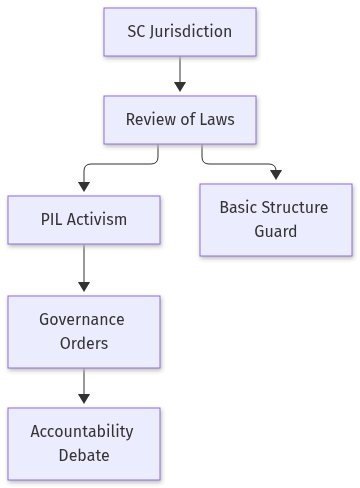
Conclusion
Judicial review was designed in; activism accreted through PIL and creative interpretation — strengthening rights protection but requiring discipline to avoid supplanting elected policy.
Quick related
Students also ask
-
Present the picture of industrial development in Bihar and compare with industrial development of India. Indicate the causes of industrial backwardness in this State and illustrate the recent remedial steps taken by the Government of Bihar to improve the situation.
Next question on this syllabus topic (2022 · Q5). View answer →
-
Difference between review and activism?
Review tests constitutionality of actions; activism proactively shapes policy via PIL and continuing mandamus.
-
Is activism justified in Bihar context?
Where executive failure on rights (e.g., detention, child labour) appears, PIL can be corrective yet must respect separation of powers.
More from this topic
Q8 · UPSC Mains 2025 · GS II · 36 marks · Solution
(a) In the perspective of the basics of cyber security, the need for digital sovereignty and the effectiveness of the Prevention of Money Laundering Act (PMLA), suggest components for a comprehensive internal security strategy. Or (b) “The New Indian Space Policy 2023 has opened the floodgates for the private sector.” Is this transition merely about technological development, or has it qualitatively transformed India’s capabilities for national security disaster response and border management? In the context of drone swarm technology, the security of satellite based communication and the strategic significance of GSLV program, propose the essential pillars of a comprehensive ‘Security-Development-Innovation’ strategy for India’s space and allied technologies.
General Studies II
India’s internal security and strategic posture increasingly depend on space-based C4ISR, private innovation under the 2023 Space Policy, and allied technologies (drones, secure satcom, GSLV-class lift) for disaster and border missions.
Q7 · UPSC Mains 2025 · GS II · 36 marks · Solution
Write short answer of the following questions: (See official booklet Section III short notes — cyber security / digital sovereignty / PMLA components and remaining short parts in media/pyq/2025/BPGS2-english.pdf.) In the perspective of the basics of cyber security, the need for digital sovereignty and the effectiveness of the Prevention of Money Laundering Act (PMLA), suggest components for a comprehensive internal security strategy. (Full short-note set: official PDF.)
General Studies II
Internal security in a digital age requires cyber resilience, sovereign control over critical data infrastructure, and anti-money-laundering architecture — PMLA being one pillar among intelligence, policing, and border coordination.
Q6 · UPSC Mains 2025 · GS II · 38 marks · Solution
(a) Discuss the major ports on eastern coast of India. Critically examine the role of Syama Prasad Mookerjee Port, Kolkata (SMPK) in the development of North East India and Bangladesh, giving suitable examples. Or (b) Describe the concept of fourth industrial revolution (Industry 4.0). Critically analyse the biggest benefits and risks of adopting industry 4.0 technologies in India.
General Studies II
Eastern seaboard ports anchor coal, container, and bulk trade for eastern India; SMPK (Kolkata) retains historic hinterland ties to North-East India and Bangladesh via river-sea multimodal networks despite draft limitations.