Revision summary
Chhath is a lunar festival venerating Surya and Chhathi Maiya, concentrated in Bihar–Purvanchal; diaspora celebration, reverse migration, and local informal economy effects make it a transnational cultural asset with measurable remittance and tourism spillovers.
Model answer
Introduction
Rooted in folk observance along the Ganga plains, Chhath has scaled from village ghats to global urban waterfronts as Bihari migration expanded to metros and the Gulf.
Body
Social Dimensions
- Peg: Four-day vrata emphasises purity, gender-shared ritual labour, and community kitchens (thekua preparation); reinforces neighbourhood solidarity at ghats.
- Peg: Inclusive participation across castes when observing vrati families; public ghats become temporary commons managed by local committees.
- Peg: Urban Chhath in Delhi, Mumbai, and Patna tests municipal capacity for crowd safety and water quality.
Cultural Dimensions
- Peg: Folk songs (Chhath geet), prostration arghya at sunrise/sunset, and river symbolism sustain oral traditions beyond temple priesthoods.
- Peg: UNESCO intangible heritage discourse and state patronage (Bihar tourism campaigns) globalise a previously regional rite.
- Peg: Media and OTT coverage standardise iconography while local variants (ponds vs. rivers) persist.
Economic Dimensions
- Peg: Seasonal demand spikes for sugarcane, fruits, bamboo baskets, and textiles; informal vendors cluster at ghats and railway stations.
- Peg: Tourism packages to Patna, Darbhanga, and Muzaffarpur ghats; hospitality uptick during Kartik month.
- Peg: Remittance inflows often timed to festival expenses; NREGA and urban wages channel into rural consumption.
Migration Linkages
- Peg: Bihari diaspora replicates Chhath at artificial ponds worldwide, maintaining kin networks and hometown political ties.
- Peg: Reverse migration surges before Chhath — strains transport, raises ticket prices, yet strengthens village social capital.
- Peg: Policy angle: safe travel windows, ghat infrastructure along Punpun–Ganga–Kosi belts, and skill retention in home districts.
Governance and Sustainability
- Peg: River pollution undermines ritual purity narrative; need for eco-ghats and waste collection post-arghya.
- Peg: Women’s safety, lighting, and medical camps at mega-ghats are now standard state interventions in Bihar.
- Peg: Cultural economy branding can align with state handicraft and food-processing schemes if quality controls improve.
Flow diagram
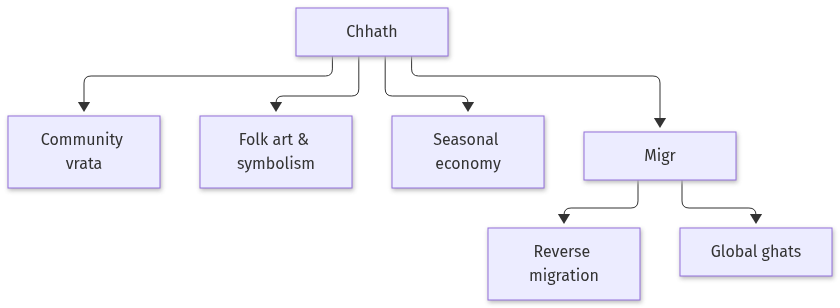
Conclusion
Chhath is simultaneously devotional practice, migration calendar, and informal economic festival — understanding it sociologically is essential for Bihar-centric GS answers on culture and development.
Quick related
Students also ask
-
In respect of hospital data given in Table 1, answer the following questions. (Table in official booklet — July 2025 hospital outcome data by department and gender.)
(a) Which department has highest percentage of female patients?
(b) What is ratio of Neurology patients to Cardiology patients among male patients?
(c) Which departments have more than one-fourth of the total admissions, respectively in each gender category?
(d) Which department has highest ratio of specialized care to cured ratio for male and female combined group?
(e) If one more female was admitted to specialized care and cured category each and one less male under cured category in the Cardiology department, then what would be the overall ratios of specialized care to cured under each gender?
Or
In respect of data from Fig. 1 for population aged above 60, answer the questions that follow. (Figure in official booklet.)
Next question on this syllabus topic (2025 · Q7). View answer →
-
How does Chhath connect to Bihar's migration story?
Festival timing drives reverse migration and remittance spending, while diaspora communities recreate ghats abroad to preserve identity.
-
What economic effects does Chhath generate locally?
Short-term boosts to vendors, transport, hospitality, and agro-processing around ritual foods and riverfront infrastructure.
More from this topic
Q8 · UPSC Mains 2025 · GS I · 36 marks · Solution
Section III statistical / graph / diagram question continuing from the official booklet (Fig. 1 persons aged 60+ by gender and residence, and remaining sub-questions). See media/pyq/2025/BPGS1-english.pdf for the printed figures and full sub-parts.
General Studies I
Fig. 1 items typically combine bar or pie readings on elderly population by gender and rural–urban residence; approach mirrors percentage change, share comparison, and dual-filter reading.
Q7 · UPSC Mains 2025 · GS I · 36 marks · Solution
In respect of hospital data given in Table 1, answer the following questions. (Table in official booklet — July 2025 hospital outcome data by department and gender.) (a) Which department has highest percentage of female patients? (b) What is ratio of Neurology patients to Cardiology patients among male patients? (c) Which departments have more than one-fourth of the total admissions, respectively in each gender category? (d) Which department has highest ratio of specialized care to cured ratio for male and female combined group? (e) If one more female was admitted to specialized care and cured category each and one less male under cured category in the Cardiology department, then what would be the overall ratios of specialized care to cured under each gender? Or In respect of data from Fig. 1 for population aged above 60, answer the questions that follow. (Figure in official booklet.)
General Studies I
Method-focused WRAP for Section III Table 1: filters female share by department, male neurology-to-cardiology ratio, departments exceeding one-fourth admissions, specialised-care-to-cured ratios, and the stated counterfactual in cardiology — all computed strictly from the printed booklet.
Q5 · UPSC Mains 2025 · GS I · 38 marks · Solution
(a) Discuss the India-European Free Trade Association (EFTA) Trade and Economic Partnership Agreement (TEPA), signed on 10 March 2024, which came into effect on 1 October 2025. Also, explain the economic and strategic implications of India-EU relations. Or (b) The UN Sustainable Development Goals (SDGs), also known as the Global Goals, have been in effect for ten years since their adoption in September 2015. Examine India's progress and challenges in achieving the United Nations' Sustainable Development Goals.
General Studies I
TEPA with Iceland, Liechtenstein, Norway, and Switzerland trades market access for a binding USD 100 billion investment and jobs pledge over 15 years, while India–EU ties pivot on FTA talks, green partnership, and strategic autonomy amid China–Russia stress.