Revision summary
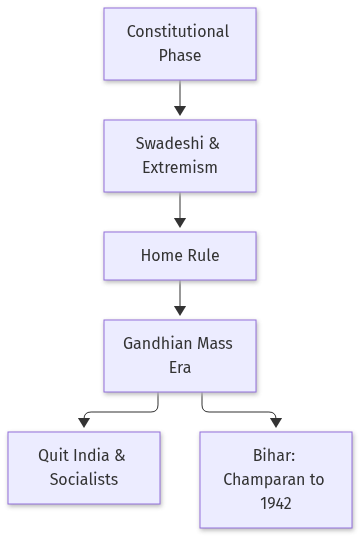
The answer follows a chronological arc from pre-Congress associations through moderates, Swadeshi, Home Rule, Gandhian mass phases, and late colonial radicalism, pegging Bihar at Champaran, non-cooperation, Civil Disobedience, Quit India, and socialist currents.
Model answer
Introduction
India’s freedom struggle evolved from petition politics to nation-wide satyagraha; Bihar’s geography, peasant structure, and bilingual press made it a recurring laboratory for all-India tactics.
Body
Early Constitutional Agitation (1870s–1905)
- Peg: Poona Sarvajanik Sabha, Indian Association, and early Congress focused on councils expansion, administrative reform, and economic critique (drain theory).
- Peg: Moderates used petitions, legislative speeches, and legal profession; limited mass base but built nationalist vocabulary.
- Peg: In Bihar, educated Kayastha–Bhumihar–Muslim elites linked Patna and Calcutta Presidency politics.
Swadeshi, Extremism, and Home Rule (1905–1918)
- Peg: Partition of Bengal, boycott–swadeshi, and revolutionary underground widened participation beyond lawyers.
- Peg: Lucknow Pact (1916) and Home Rule leagues prepared ground for mass politics post–World War I.
- Peg: Bihar contributed leaders like Mazharul Haque; Champaran agrarian crisis awaited Gandhian intervention.
Gandhian Mass Mobilisation (1917–1934)
- Peg: Champaran Satyagraha (1917) linked peasants to national leadership; Non-Cooperation (1920–22) and Civil Disobedience (1930–34) institutionalised parishad–ashram networks.
- Peg: Salt March symbolism, no-tax campaigns, and student strikes in Patna, Muzaffarpur, and Bhagalpur integrated Bihar into all-India schedules.
- Peg: Gandhi–Irwin Pact and Round Table politics fragmented unity yet kept Congress as central negotiator.
Radicalisation and Late Colonial Phase (1935–1947)
- Peg: 1937 provincial autonomy saw Congress ministries; Kisan Sabha and socialist groups pressed class issues.
- Peg: Quit India (1942) brought parallel governments and JP–led underground activity in Bihar.
- Peg: 1946–47 communal violence and Partition negotiations shifted focus to state formation; Bihar absorbed migration streams.
Bihar at Critical Junctures — Synthesis
- Peg: Permanent themes: peasant question (Champaran, tenancy laws), Hindi–Urdu public sphere, and student–worker mobilisation in Patna.
- Peg: Bihar rarely initiated all-India strategy but executed mass phases efficiently, giving depth to Congress and socialist wings.
- Peg: Post-independence, the same networks fed JP’s Sarvodaya and later anti-Emergency resistance.
Flow diagram
Conclusion
The national movement’s morphology — from memorials to the Raj to mass civil disobedience — cannot be written without Bihar’s peasant belts and provincial Congress machinery; BPSC answers gain marks by dating each juncture and naming local sites.
Quick related
Students also ask
-
Answer the following questions:
(a) Discuss the World Health Organization (WHO) concerns over gaps in India's Drug Safety Regulations in the pharmaceutical Sector.
(b) Write a note on the role of Adi Karmayogi Abhiyan and Tribal Village Vision 2030 Declaration towards greater decentralisation.
(c) The Promotion and Regulation of Online Gaming Bill, 2025, has been passed by the Parliament. How can this law promote e-sports and online social games, while also protecting youth and society from fraud and social evils?
(d) Write a note on the increasing surge in anti-immigration rhetoric, protests, and policies worldwide from Western democracies to parts of Asia.
(e) Explain the India-Afghanistan relations and the strategic resetting of ties with the visit of the foreign minister of Afghanistan.
Next question on this syllabus topic (2025 · Q4). View answer →
-
What marks the shift from moderate to mass nationalism?
The transition is marked by boycott–swadeshi, Gandhian satyagraha linking peasants and workers, and nationwide hartals rather than council speeches alone.
-
Where does Bihar fit in the Gandhian phase?
Champaran began peasant satyagraha; later Bihar hosted major Civil Disobedience and Quit India activity through district Congress and socialist cadres.
More from this topic
Q8 · UPSC Mains 2025 · GS I · 36 marks · Solution
Section III statistical / graph / diagram question continuing from the official booklet (Fig. 1 persons aged 60+ by gender and residence, and remaining sub-questions). See media/pyq/2025/BPGS1-english.pdf for the printed figures and full sub-parts.
General Studies I
Fig. 1 items typically combine bar or pie readings on elderly population by gender and rural–urban residence; approach mirrors percentage change, share comparison, and dual-filter reading.
Q7 · UPSC Mains 2025 · GS I · 36 marks · Solution
In respect of hospital data given in Table 1, answer the following questions. (Table in official booklet — July 2025 hospital outcome data by department and gender.) (a) Which department has highest percentage of female patients? (b) What is ratio of Neurology patients to Cardiology patients among male patients? (c) Which departments have more than one-fourth of the total admissions, respectively in each gender category? (d) Which department has highest ratio of specialized care to cured ratio for male and female combined group? (e) If one more female was admitted to specialized care and cured category each and one less male under cured category in the Cardiology department, then what would be the overall ratios of specialized care to cured under each gender? Or In respect of data from Fig. 1 for population aged above 60, answer the questions that follow. (Figure in official booklet.)
General Studies I
Method-focused WRAP for Section III Table 1: filters female share by department, male neurology-to-cardiology ratio, departments exceeding one-fourth admissions, specialised-care-to-cured ratios, and the stated counterfactual in cardiology — all computed strictly from the printed booklet.
Q6 · UPSC Mains 2025 · GS I · 38 marks · Solution
(a) In recent years, the Chhath festival has gained increasing global attention. Discuss the Social, cultural and economic impact of Chhath and its linkages with migration. Or (b) Bihar has emerged as the top-performing state in the country in the ‘Prime Minister Formalization Micro Food Processing Enterprises Upgradation’ (PMFME) Scheme. Analyse the potential PMFME towards contribution in the economic development of the Urban and Rural areas in Bihar.
General Studies I
Chhath is a lunar festival venerating Surya and Chhathi Maiya, concentrated in Bihar–Purvanchal; diaspora celebration, reverse migration, and local informal economy effects make it a transnational cultural asset with measurable remittance and tourism spillovers.