Revision summary
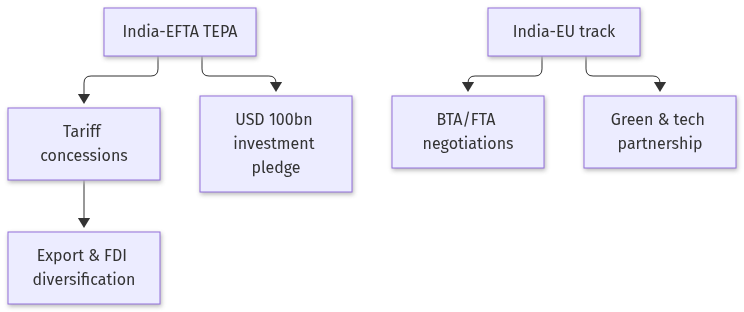
TEPA with Iceland, Liechtenstein, Norway, and Switzerland trades market access for a binding USD 100 billion investment and jobs pledge over 15 years, while India–EU ties pivot on FTA talks, green partnership, and strategic autonomy amid China–Russia stress.
Model answer
Introduction
India’s trade diplomacy couples modular agreements with large partners (EFTA) while the EU remains the broadest regulatory market negotiation — both shape Bihar-linked pharma, leather, and IT services indirectly.
Body
India–EFTA TEPA — Core Features
- Peg: Signed 10 March 2024 by India and four EFTA states; entered into force 1 October 2025 after ratifications.
- Peg: India opens tariff lines for industrial goods over long staging; EFTA grants preferential access for Indian exports and commits to promote FDI.
- Peg: Distinctive binding investment chapter: target of USD 100 billion foreign investment and one million direct jobs over 15 years — unusual in Indian FTAs.
Sectoral and Regulatory Implications
- Peg: Benefits precision engineering, pharmaceuticals, chemicals, and services firms seeking Swiss/Nordic markets; dairy and sensitive agriculture remain guarded.
- Peg: Intellectual property, public procurement, and dispute settlement align with modern templates; SMEs need compliance readiness for EU-adjacent standards via EFTA hubs.
- Peg: EFTA states gain portfolio diversification beyond traditional EU single-market routing.
India–EU Relations — Economic Track
- Peg: EU is among India’s largest trading partners; Bilateral Trade and Investment Agreement talks resumed after hiatus, focusing on tariffs, GIs, and sustainable development chapters.
- Peg: Green hydrogen, solar equipment, and critical minerals dialogues complement trade; carbon border adjustment mechanism pressures export carbon accounting.
- Peg: Bihar’s migrant workforce in logistics and services indirectly gains from EU-facing IT and back-office chains headquartered in India.
India–EU Relations — Strategic Track
- Peg: Indo-Pacific, connectivity (India–Middle East–Europe Corridor discourse), and Ukraine war fallout shape EU expectations on strategic alignment without formal alliance.
- Peg: Technology partnerships (semiconductors, 5G, AI governance) and defence industrial cooperation deepen beyond commerce.
- Peg: Migration, mobility, and education pacts complement hard economic bargains.
Opportunities and Risks
- Peg: TEPA can catalyse niche FDI in renewable machinery and food processing if state policies (including Bihar’s MSME schemes) absorb spillovers.
- Peg: Slow EU FTA progress pushes India toward modular deals (EFTA, UK, Australia); regulatory fragmentation tests exporters.
- Peg: Geopolitical sanctions regimes require careful banking and compliance channels for rupee–euro trade.
Flow diagram
Conclusion
TEPA converts EFTA’s small but capital-rich markets into an investment–jobs bargain for India, while the EU relationship remains the strategic prize — demanding synchronized trade, climate, and security bargaining for sustainable gains.
Quick related
Students also ask
-
(a) In recent years, the Chhath festival has gained increasing global attention. Discuss the Social, cultural and economic impact of Chhath and its linkages with migration.
Or
(b) Bihar has emerged as the top-performing state in the country in the ‘Prime Minister Formalization Micro Food Processing Enterprises Upgradation’ (PMFME) Scheme. Analyse the potential PMFME towards contribution in the economic development of the Urban and Rural areas in Bihar.
Next question on this syllabus topic (2025 · Q6). View answer →
-
How is TEPA different from a standard FTA?
It couples tariff liberalisation with a binding long-term foreign investment and employment target from EFTA states into India.
-
Why do India–EU talks progress slowly despite TEPA with EFTA?
EU negotiations cover wider agriculture, labour, and climate regulatory alignment, requiring deeper domestic reforms than the smaller EFTA package.
More from this topic
Q8 · UPSC Mains 2025 · GS I · 36 marks · Solution
Section III statistical / graph / diagram question continuing from the official booklet (Fig. 1 persons aged 60+ by gender and residence, and remaining sub-questions). See media/pyq/2025/BPGS1-english.pdf for the printed figures and full sub-parts.
General Studies I
Fig. 1 items typically combine bar or pie readings on elderly population by gender and rural–urban residence; approach mirrors percentage change, share comparison, and dual-filter reading.
Q7 · UPSC Mains 2025 · GS I · 36 marks · Solution
In respect of hospital data given in Table 1, answer the following questions. (Table in official booklet — July 2025 hospital outcome data by department and gender.) (a) Which department has highest percentage of female patients? (b) What is ratio of Neurology patients to Cardiology patients among male patients? (c) Which departments have more than one-fourth of the total admissions, respectively in each gender category? (d) Which department has highest ratio of specialized care to cured ratio for male and female combined group? (e) If one more female was admitted to specialized care and cured category each and one less male under cured category in the Cardiology department, then what would be the overall ratios of specialized care to cured under each gender? Or In respect of data from Fig. 1 for population aged above 60, answer the questions that follow. (Figure in official booklet.)
General Studies I
Method-focused WRAP for Section III Table 1: filters female share by department, male neurology-to-cardiology ratio, departments exceeding one-fourth admissions, specialised-care-to-cured ratios, and the stated counterfactual in cardiology — all computed strictly from the printed booklet.
Q6 · UPSC Mains 2025 · GS I · 38 marks · Solution
(a) In recent years, the Chhath festival has gained increasing global attention. Discuss the Social, cultural and economic impact of Chhath and its linkages with migration. Or (b) Bihar has emerged as the top-performing state in the country in the ‘Prime Minister Formalization Micro Food Processing Enterprises Upgradation’ (PMFME) Scheme. Analyse the potential PMFME towards contribution in the economic development of the Urban and Rural areas in Bihar.
General Studies I
Chhath is a lunar festival venerating Surya and Chhathi Maiya, concentrated in Bihar–Purvanchal; diaspora celebration, reverse migration, and local informal economy effects make it a transnational cultural asset with measurable remittance and tourism spillovers.