Revision summary
This BPSC answer examines the monumental features of Mauryan art and architecture, categorising them into court art and popular art. It details monolithic pillars, rock-cut architecture, stupas, and sculptures like yakshas. The analysis connects these artistic expressions to imperial centralisation, Dhamma propagation, and cultural synthesis. It highlights how art served as a visual instrument of political legitimacy and moral governance. The conclusion links the architectural legacy to India's enduring heritage of public welfare and ethical statecraft.
Model answer
Introduction
The Mauryan Empire marked a watershed in Indian art, transitioning from wood and clay to durable stone architecture. Patronised heavily by the state, these creations served as tangible symbols of imperial authority and ethical governance under Ashoka's Dhamma.
Body
Categorisation of Mauryan Art
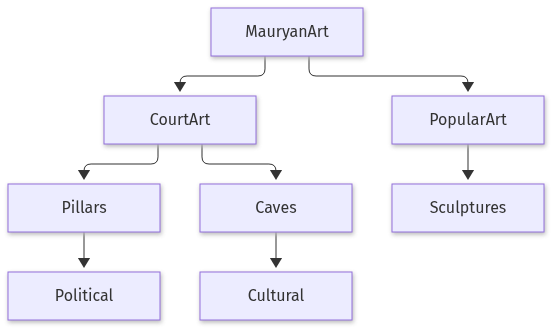
Mauryan artistic output is broadly bifurcated into court art, reflecting royal patronage, and popular art, representing indigenous local traditions.
- Court Art: Comprises monolithic Ashokan pillars, royal palaces at Kumhrar, rock-cut caves in the Barabar hills, and polished stupas reflecting high technological mastery.
- Popular Art: Includes monumental stone sculptures of local deities like Yakshas and Yakshinis, terracotta figurines, and pottery showing continuous indigenous craftsmanship.
Architectural and Sculptural Features
Mauryan monuments display distinctive technical brilliance, characterised by uniform Chunar sandstone and a mirror-like polish.
- Monolithic Pillars: Carved out of single sandstone blocks, featuring tapered shafts, bell-shaped capitals, and symbolic animal figures with high surface gloss.
- Rock-Cut Architecture: Highly polished interiors of Barabar and Nagarjuni caves demonstrate advanced stone-cutting techniques for ascetic retreats.
- Stupas and Sculptures: Brick and stone stupas like Sanchi symbolised cosmic order, while sculptures such as the Didarganj Yakshini displayed realistic bodily proportions.
Expression of Political Values
Art served as an instrument of political centralisation, imperial integration, and moral authority.
- Imperial Power: Massive palace ruins at Kumhrar and towering pillars projecting the king's sovereign writ across distant provinces.
- Dhamma and Governance: Ashokan edicts inscribed on rocks and pillars communicated moral precepts, pacifism, and royal welfare duties directly to subjects.
Expression of Cultural Values
Mauryan art synthesized diverse indigenous motifs, foreign influences, and spiritual traditions.
- Syncretism: Integration of Persian bell-shaped capitals with indigenous symbolism like the lotus, wheel, and sacred animals.
- Spiritual Pluralism: Patronage extended to Buddhism, Jainism (Ajivikas in caves), and popular folk deities, reflecting a tolerant cultural milieu.
Flow diagram
Conclusion
Mauryan art and architecture transcended mere aesthetic indulgence, functioning as a vital instrument of imperial integration and moral instruction. By marrying technical mastery with the ethical imperatives of Dhamma, the Mauryans created a monumental legacy that shaped subsequent traditions of Indian art and statecraft.
Quick related
Students also ask
-
(a) Discuss the transformation of the Indian national movement from early constitutional agitation to mass mobilisation, highlighting Bihar’s role at different historical junctures.
Or
(b) To what extent did Nehru’s foreign policy reflect idealism and pragmatism? Examine with reference to its main features.
Next question on this syllabus topic (2025 · Q3). View answer →
-
What are the main features of Mauryan art and architecture for BPSC Mains?
Mauryan art is classified into court art (pillars, stupas, palaces, caves) and popular art (sculptures of Yakshas and Yakshinis). Key features include Chunar sandstone usage, high polish, and monolithic construction.
-
How did Mauryan art express political and cultural values?
It expressed political centralisation and imperial authority through towering pillars and edicts promulgating Ashoka's Dhamma. Culturally, it reflected syncretism, blending indigenous motifs with foreign influences and supporting diverse religious sects.
More from this topic
Q8 · UPSC Mains 2025 · GS I · 36 marks · Solution
Section III statistical / graph / diagram question continuing from the official booklet (Fig. 1 persons aged 60+ by gender and residence, and remaining sub-questions). See media/pyq/2025/BPGS1-english.pdf for the printed figures and full sub-parts.
General Studies I
Fig. 1 items typically combine bar or pie readings on elderly population by gender and rural–urban residence; approach mirrors percentage change, share comparison, and dual-filter reading.
Q7 · UPSC Mains 2025 · GS I · 36 marks · Solution
In respect of hospital data given in Table 1, answer the following questions. (Table in official booklet — July 2025 hospital outcome data by department and gender.) (a) Which department has highest percentage of female patients? (b) What is ratio of Neurology patients to Cardiology patients among male patients? (c) Which departments have more than one-fourth of the total admissions, respectively in each gender category? (d) Which department has highest ratio of specialized care to cured ratio for male and female combined group? (e) If one more female was admitted to specialized care and cured category each and one less male under cured category in the Cardiology department, then what would be the overall ratios of specialized care to cured under each gender? Or In respect of data from Fig. 1 for population aged above 60, answer the questions that follow. (Figure in official booklet.)
General Studies I
Method-focused WRAP for Section III Table 1: filters female share by department, male neurology-to-cardiology ratio, departments exceeding one-fourth admissions, specialised-care-to-cured ratios, and the stated counterfactual in cardiology — all computed strictly from the printed booklet.
Q6 · UPSC Mains 2025 · GS I · 38 marks · Solution
(a) In recent years, the Chhath festival has gained increasing global attention. Discuss the Social, cultural and economic impact of Chhath and its linkages with migration. Or (b) Bihar has emerged as the top-performing state in the country in the ‘Prime Minister Formalization Micro Food Processing Enterprises Upgradation’ (PMFME) Scheme. Analyse the potential PMFME towards contribution in the economic development of the Urban and Rural areas in Bihar.
General Studies I
Chhath is a lunar festival venerating Surya and Chhathi Maiya, concentrated in Bihar–Purvanchal; diaspora celebration, reverse migration, and local informal economy effects make it a transnational cultural asset with measurable remittance and tourism spillovers.