Revision summary
Five notes cover early council expansion, Bihar’s 1942 resistance, tribal revolt of 1855, regional miniature school, and Mauryan stone culture.
Model answer
Introduction
Section I mini-notes demand precise dates, personalities, and consequence lines for BPSC history.
Body
(a) Indian Councils Act, 1861
- Peg: First major expansion after Company rule; introduced non-official Indians into Viceroy’s and provincial councils.
- Peg: Enabled legislative deliberation on budgets; Indians gained voice without executive responsibility.
- Peg: Laid institutional basis for later nationalist demands for wider representation.
(b) Role of Bihar in Quit India Movement
- Peg: Mass hartals after 9 August 1942; destruction of rail and telegraph across Patna, Mokama, and Sasaram divisions.
- Peg: JP and socialist cadres formed underground networks; parallel government attempts in parts of the province.
- Peg: Repression arrested thousands; movement crippled organisationally but signalled popular anti-colonial will.
(c) Santhal Uprising (1855–56)
- Peg: Sidhu and Kanhu Murmu led Santhals in present Jharkhand–Bihar belt against moneylenders, zamindars, and corrupt police.
- Peg: Declared end of Company rule in tribal hinterland; suppressed violently; led to creation of Santhal Parganas.
- Peg: Landmark agrarian–tribal revolt preceding 1857.
(d) Patna Kalam Painting
- Peg: Indo-Persian miniature school patronised by Patna painters (Ghulam Kasim, Hulas Lall, Shivlal) c. late 18th–19th centuries.
- Peg: Themes: bazaar scenes, Mughal-influenced portraiture, folk life; distinct from Mughal court at Delhi.
- Peg: Declined with photography and Company art markets; revived as heritage craft.
(e) Art and Architecture of Mauryan Age
- Peg: Court art: Ashokan pillars, Barabar–Nagarjuni caves (Bihar), palace remains at Kumhrar.
- Peg: Popular art: yaksha–yakshini sculptures, terracottas; high polish on Chunar sandstone.
- Peg: Art projected imperial integration and Ashokan Dhamma ethics.
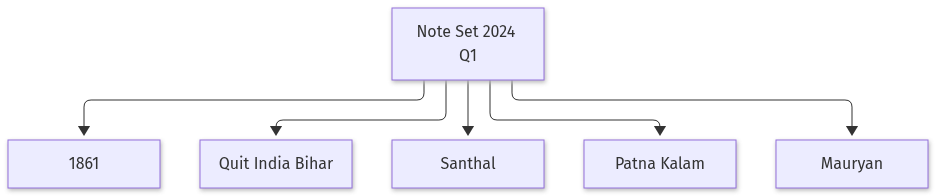
Flow diagram
Conclusion
These five themes span council politics, tribal and mass nationalism, regional painting, and classical Bihar archaeology.
Quick related
Students also ask
-
(a) Describe the Champaran Indigo Movement and explain its impacts on the Indian freedom struggle.
Or
(b) How far the British policy was responsible for the emergence of Indian National Movement? Explain.
Next question on this syllabus topic (2024 · Q2). View answer →
-
Why is Santhal revolt taught with 1857?
It exposed structural exploitation in eastern tribal belts just before the wider sepoy rebellion.
-
What is unique about Patna Kalam?
Its bazaar realism and Patna-based artisan line distinct from Mughal court workshops.
More from this topic
Q8 · UPSC Mains 2025 · GS I · 36 marks · Solution
Section III statistical / graph / diagram question continuing from the official booklet (Fig. 1 persons aged 60+ by gender and residence, and remaining sub-questions). See media/pyq/2025/BPGS1-english.pdf for the printed figures and full sub-parts.
General Studies I
Fig. 1 items typically combine bar or pie readings on elderly population by gender and rural–urban residence; approach mirrors percentage change, share comparison, and dual-filter reading.
Q7 · UPSC Mains 2025 · GS I · 36 marks · Solution
In respect of hospital data given in Table 1, answer the following questions. (Table in official booklet — July 2025 hospital outcome data by department and gender.) (a) Which department has highest percentage of female patients? (b) What is ratio of Neurology patients to Cardiology patients among male patients? (c) Which departments have more than one-fourth of the total admissions, respectively in each gender category? (d) Which department has highest ratio of specialized care to cured ratio for male and female combined group? (e) If one more female was admitted to specialized care and cured category each and one less male under cured category in the Cardiology department, then what would be the overall ratios of specialized care to cured under each gender? Or In respect of data from Fig. 1 for population aged above 60, answer the questions that follow. (Figure in official booklet.)
General Studies I
Method-focused WRAP for Section III Table 1: filters female share by department, male neurology-to-cardiology ratio, departments exceeding one-fourth admissions, specialised-care-to-cured ratios, and the stated counterfactual in cardiology — all computed strictly from the printed booklet.
Q6 · UPSC Mains 2025 · GS I · 38 marks · Solution
(a) In recent years, the Chhath festival has gained increasing global attention. Discuss the Social, cultural and economic impact of Chhath and its linkages with migration. Or (b) Bihar has emerged as the top-performing state in the country in the ‘Prime Minister Formalization Micro Food Processing Enterprises Upgradation’ (PMFME) Scheme. Analyse the potential PMFME towards contribution in the economic development of the Urban and Rural areas in Bihar.
General Studies I
Chhath is a lunar festival venerating Surya and Chhathi Maiya, concentrated in Bihar–Purvanchal; diaspora celebration, reverse migration, and local informal economy effects make it a transnational cultural asset with measurable remittance and tourism spillovers.