Revision summary
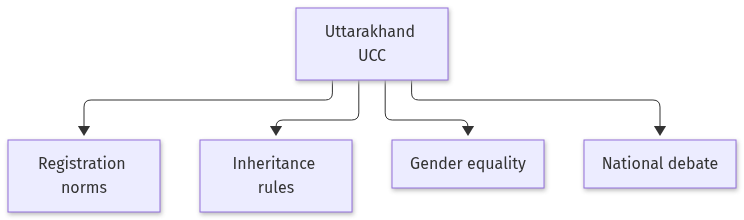
Uttarakhand's Uniform Civil Code (2024 framework) standardises marriage, divorce, inheritance, and live-in registration, provoking national debate on plurality vs. equality.
Model answer
Introduction
Article 44 Directive Principle inspires state-led UCC experiments; Uttarakhand offers the first operational template.
Body
What the Uttarakhand UCC Entails
- Peg: Uniform rules on marriage age, divorce grounds, maintenance, inheritance, and property for all residents regardless of religion (with stated exceptions where constitutionally required).
- Peg: Mandatory registration of marriages and live-in relationships; equal inheritance rights framed in gender-neutral language.
- Peg: State committee drafted code after wide consultation; enacted by Uttarakhand assembly 2024.
Social and Cultural Implications
- Peg: May reduce parallel personal-law practices in public administration but challenges customary tribal codes in hills.
- Peg: Women's property and maintenance claims potentially strengthened; community organisations voice identity concerns.
- Peg: Public awareness campaigns needed to prevent informal unions from legal vulnerability.
Religious Dimensions
- Peg: Muslim, Christian, and Hindu personal-law traditions interact differently with uniform inheritance and divorce timelines.
- Peg: Places of worship governance untouched, but family law convergence alters ritual–legal boundaries (e.g. nikah registration parity).
Legal and Institutional Changes
- Peg: New registrar infrastructure, digital marriage databases, and harmonised succession procedures.
- Peg: Courts apply single code — reduces forum shopping; appellate clarity expected over time.
- Peg: Other states (Gujarat debates, Assam statements) watch Uttarakhand litigation and compliance rates.
Evaluation
- Peg: Progressive on gender equality metrics; contentious on live-in policing and tribal autonomy.
- Peg: National UCC requires Parliament and broader consensus; Uttarakhand is pilot, not automatic blueprint.
Flow diagram
Conclusion
Uttarakhand's UCC tests whether uniform family law can advance gender justice without erasing legitimate cultural diversity — the constitutional question Article 44 has long deferred.
Quick related
Students also ask
-
(a) Discuss the concept of ‘One Nation, One Election’ and its implication on the federal Structure of India. What are the potential advantages and disadvantages of synchronizing elections to the Lok Sabha and State Assemblies? Analyze.
Or
(b) Throwing light on the increasing women participation in Indian politics and society and the Women's Reservation Act, 2023 (Narishakti Vandan Act, 2023), Analyze the social, economic and political changes taking place in Indian society due to its implementation.
Next question on this syllabus topic (2024 · Q6). View answer →
-
Does UCC abolish all personal laws immediately?
It supersedes conflicting family-law practices in state jurisdiction for covered subjects, subject to constitutional rights and judicial review.
-
Can Bihar copy Uttarakhand?
Family law is in Concurrent List; states may legislate but must align with fundamental rights and possible central legislation.
More from this topic
Q8 · UPSC Mains 2025 · GS I · 36 marks · Solution
Section III statistical / graph / diagram question continuing from the official booklet (Fig. 1 persons aged 60+ by gender and residence, and remaining sub-questions). See media/pyq/2025/BPGS1-english.pdf for the printed figures and full sub-parts.
General Studies I
Fig. 1 items typically combine bar or pie readings on elderly population by gender and rural–urban residence; approach mirrors percentage change, share comparison, and dual-filter reading.
Q7 · UPSC Mains 2025 · GS I · 36 marks · Solution
In respect of hospital data given in Table 1, answer the following questions. (Table in official booklet — July 2025 hospital outcome data by department and gender.) (a) Which department has highest percentage of female patients? (b) What is ratio of Neurology patients to Cardiology patients among male patients? (c) Which departments have more than one-fourth of the total admissions, respectively in each gender category? (d) Which department has highest ratio of specialized care to cured ratio for male and female combined group? (e) If one more female was admitted to specialized care and cured category each and one less male under cured category in the Cardiology department, then what would be the overall ratios of specialized care to cured under each gender? Or In respect of data from Fig. 1 for population aged above 60, answer the questions that follow. (Figure in official booklet.)
General Studies I
Method-focused WRAP for Section III Table 1: filters female share by department, male neurology-to-cardiology ratio, departments exceeding one-fourth admissions, specialised-care-to-cured ratios, and the stated counterfactual in cardiology — all computed strictly from the printed booklet.
Q6 · UPSC Mains 2025 · GS I · 38 marks · Solution
(a) In recent years, the Chhath festival has gained increasing global attention. Discuss the Social, cultural and economic impact of Chhath and its linkages with migration. Or (b) Bihar has emerged as the top-performing state in the country in the ‘Prime Minister Formalization Micro Food Processing Enterprises Upgradation’ (PMFME) Scheme. Analyse the potential PMFME towards contribution in the economic development of the Urban and Rural areas in Bihar.
General Studies I
Chhath is a lunar festival venerating Surya and Chhathi Maiya, concentrated in Bihar–Purvanchal; diaspora celebration, reverse migration, and local informal economy effects make it a transnational cultural asset with measurable remittance and tourism spillovers.